Hot on the Highstreet Week 261

Dosa at Egg sounds more like an Indian breakfast dish than a pop-up shop in Knightsbridge. Egg is a beautiful boutique that is usually known for its discreet white exterior and muted simple clothing. The Dosa pop-up at Egg is a blast of brightness, a collaboration of two artists (Christina Kim and Sam Schonzeit) and everything is pink. Needless to say this made me extremely happy.

The Dosa summer 15 collection is named ‘untitled pink field’ and is lively and high spirited. A beautiful collection of lightweight, floaty garments that showcase a range of rose hues. Smock dresses and billowing shirts make for the perfect summer wardrobe. The clothing collection is displayed on minimalist industrial rails in front of a wall installation inspired by the lotus pink sunsets of Myanmar and the pink-robed Buddhist nuns of Bagan. It is a patchwork collage of neon pink and white postcards, which are also available to buy individually.

In true Egg style there are cherries and cupcakes (all pink of course) for shoppers to pick at and pretty peonies adorning the entrance. It is a gloriously celebration of the colour pink and an immersive experience for fashion and design enthusiasts.

egg
37 Kinnerton Street London
www.eggtrading.com

Exhibition open
5th June – 25th June
10am – 6pm
Monday  – Saturday

Alexander McQueen: Savage Beauty, V&A

The genius of Alexander McQueen is a mystery to most… which is perhaps why the new exhibition at the V&A is so popular, giving a rare insight into the renowned and courageous designer.

This grand retrospective of McQueen’s career has transferred from its original home at the Metropolitan Museum of Art in New York. However as Lee was born and taught in London it feels even more monumental at the prestigious V&A museum. Appropriately named Savage Beauty, this exhibition illustrates the brutal but beautiful aspect of his creations. The artist said about himself: ‘I’m a romantic schizophrenic.’

The tailoring is stunning. There are several rooms which display pieces from Lee’s studies and earliest collections. He learnt from a variety of highly skilled masters and worked hard, using the classic techniques to create unique pieces. He gained experience at tailors Gieves and Hawkes and theatrical costumiers Angels and Bermans. McQueen strongly believed that before you can be creative you need to be technically en pointe.

The exhibition has little narrative, instead the rooms are divided by theme and collection. The Highland Rape collection was particularly memorable and shows Lee’s loyalty to his Scottish heritage. The sculptural outfits are daring and striking, made almost entirely in the McQueen tartan print, the clothes make the women look powerful and imposing.

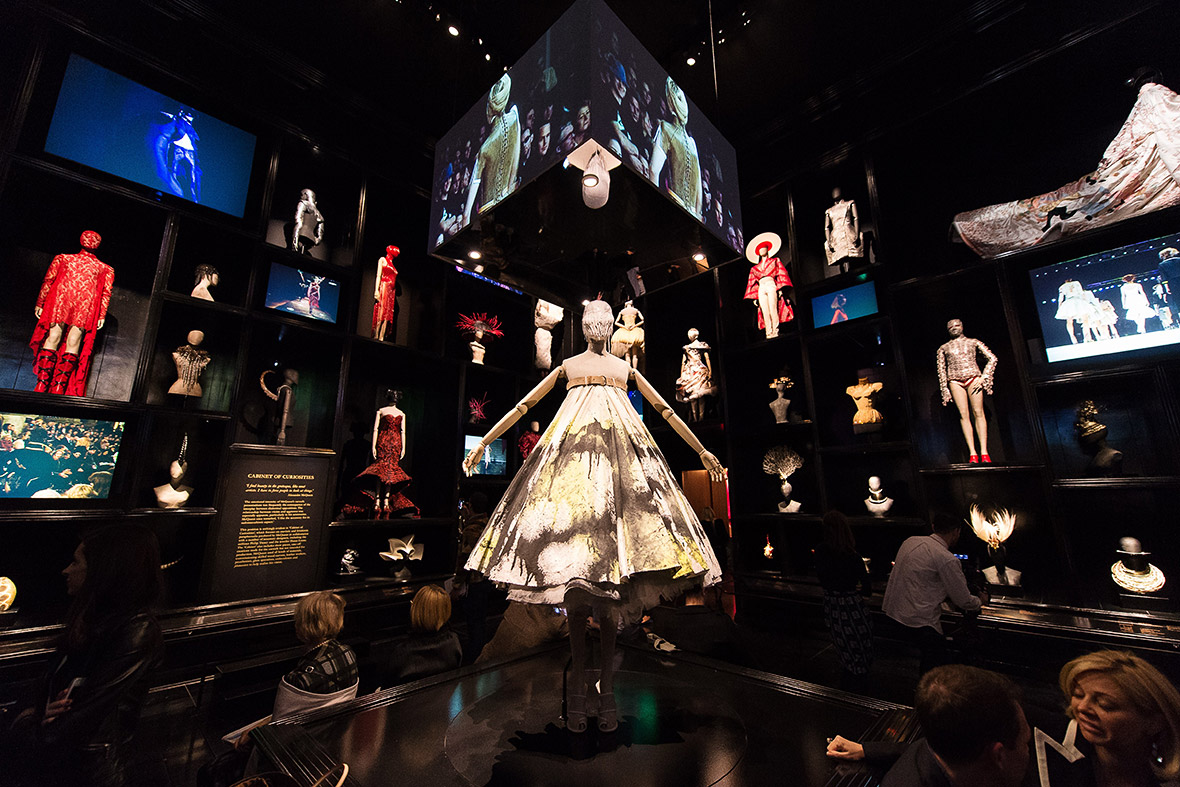
The ‘Cabinet of Curiosities’ is hypnotising, an enchanting room of fairytale accessories and garments made from unusual and unlikely materials. Each exhibit is a work of art, a technical tour de force. There is a dress made of razor clam shells and a headdress of butterflies. The clothes are intended to provoke and sometimes even disgust… but even the mud covered dresses and sinister leather zipped masks have sublime qualities.

The final room has a hint of the supernatural. Alien-like figures are dressed in figure-hugging animal print dresses. My favourite was a fully sequined iridescent frock which I stared at for ages imagining myself strutting down a catwalk beaming with confidence.
This is the immortal feeling that McQueen clothes give you, elevating you a magical version of your former self, brilliantly different and weirdly wonderful.

This extravagant exhibition immortalises the great Alexander McQueen, showcasing his imaginative and elaborate designs that will be forever inspiring to the fashion world. One thing’s for sure, there is so much more to McQueen than the commercialised skull print scarves. His vision is completely deserving of the V&A platform.

Exhibition continues until August 2, more information and book tickets here.

THOROUGHLY MODERN MAN: Salt & Silver, Tate Britain

Salt & Silver comprises four rooms of some of the earliest examples of photography, salt prints, created using light-sensitive paper coated in silver salts with paper or glass negatives. As this method of printing was only in use for around twenty years between 1840 and 1860, there are limited examples in existence and so I arrived at the show in anticipation of the collection. The four rooms were roughly laid out as follows: very early examples and experiments of salt printing, by William Henry Fox Talbot in particular; prints of modern street life and architecture; prints of historical monuments and ruins, (the images taken in Egypt were particularly striking); lastly there was a room of portraits.

The first thing that struck me about even the earliest prints was how clear and well preserved they were. Having experimented with salt printing myself, I know how difficult it is to get a defined, well-exposed image, yet the prints display a contrast and sharpness that suggest more modern technology, and it is easy to forget that the items are over 150 years old. This perhaps removed some of the romance for me, as I was hoping that the physical artefacts themselves would provide interest beyond the subjects they depict.

The early rooms I found to be a little inconsistent, with it seeming as if the curator was unsure whether to highlight experimental processes, or the best examples of salt printing. Whilst I found the emotive and dramatic nature of the prints appealing, many of the photographs left me wanting a little more in terms of composition and subject matter. There are exceptions: an Édouard Baldus print of the damage left by a flood in Lyon and a George Kendall Warren print of a Harvard rowing team on the the river, in particular. The third room, titled ‘Epic’, delivered a little more with images of ancient Egyptian ruins and other dramatic monuments; however the difficulties of producing large salt prints means that the room’s name is a little overblown, seeing as the majority of the prints are around 8 by 10 inches and lack visual impact.

The final room makes this exhibition worth the rather pricey entrance fee, however. The room, simply titled ‘Presence’, contains a concentrated selection of some of the most interesting early portraits I have seen – the informal portraits of Hill and Adamson, the remarkable portraits of Roger Fenton out in the field, not to mention the influential work of Nadar and Frénet. Fine examples of all of these are crammed into the final space, and I’m glad they were, as they stayed in my mind as I left the exhibition.

First image: Gabriel Kenny-Ryder.

Second image: John Wheeley Gough Gutch Abbey Ruins, circa 1858© Wilson Centre for Photography

Third image: Roger Fenton, Captain Mottram Andrews, 28th Regiment (1st Staffordshire) Regiment of Foot, 1855© Wilson Centre for Photography.

Exhibition continues until 7 June 2015, more information and book here.

Written by a Thoroughly Modern Man, Gabriel Kenny-Ryder.