THOROUGHLY MODERN MAN: Richard Diebenkorn, Royal Academy of Arts

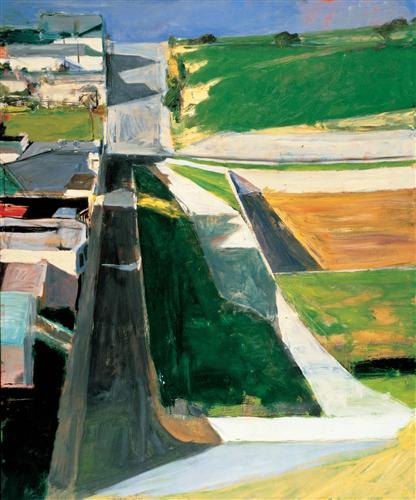
Cityscape #1, 1963

Richard Clifford Diebenkorn Jr. is an unprepossessing name for an artist whose paintings exude Californian cool. The Royal Academy’s Sackler Wing is not sunny and is best suited to displaying prints and drawings – it provides a rather gloomy environment for Diebenkorn’s clear, bright landscapes and lyrical abstracts.

The first of three rooms contains his little known Abstract Expressionist works from the 50s – exciting dynamic paintings that show the obvious influence of De Kooning. Diebenkorn’s pictures are rarely completely resolved but appear to have just stopped at an interesting point; he replaces the violence of De Kooning with floppy rhythms and wonky patches of subtle colour.

His figurative works like Girl on a Terrace from 1956 involve distracted silhouetted bystanders with the components of Edward Hopper’s ‘portraits’ but with less psychological tension. Diebenkorn’s signature Ocean Park series is heralded memorably by 1963’s masterpiece, Cityscape #1 with its satisfying balance of surface and depth, painterliness and description, energy and composure. The 1970s works in the series are airier and less argumentative, moving further from the motif and towards an easier geometric language, swopping the intense pentimenti of the earlier pictures for broad areas of confidently applied pastel colour.

Diebenkorn’s paintings take elements of Matisse and Bonnard and expand them into broad American vistas. He is a painter’s painter and the gallery was full of earnest enthusiasts leaning in to examine the surfaces from two inches away.

Diebenkorn’s euphoric art is rarely seen in this country and, while being very welcome, would benefit from a more expansive and celebratory exhibition.

Continues until 7 June 2015, more information and book here.

Written by a Thoroughly Modern Man, Chris Kenny.

THOROUGHLY MODERN MAN: Marlene Dumas: The Image as Burden, Tate Modern

Marlene Dumas paints victims: victims of oppression, abuse and misfortune. The way she paints has a damp pathos – soft big shapes: bodily, slightly shameful like a wet patch on a bed.

Her Tate Modern retrospective begins with Rejects, a composite of her signature ink and wash heads on loose sheets of paper. They started as rejects from other works but also appear as rejected individuals: wonky, dazed ghosts sometimes with their eyes cut out to reveal (more successful?) eyes beneath.

Dumas’ oil paintings have a similarly diluted aesthetic; she suggests skin, hair or moody environments with the minimum of pigment suspended in puddles that sometimes appear accidental – she always avoids any predictable depiction of the human body.

Dumas works exclusively from photographic sources which means she paints not just an individual but the position that individual holds in the media, be that a newspaper or a pornographic magazine. Sometimes we feel her sympathy for her subjects but often there is a disturbing amorality as in her ‘portraits’ of Osama bin Laden and that of his son, memorably quoted on the subject of his father: “he hated his enemies more than he loved his children”.

The handmade-ness of Dumas’s works contradicts her use of photographic and digital imagery so that she unites the two poles of visual representation – her deceptively sloppy execution cancelling out the unfeeling objectivity of mechanical observation.

The almost negligent ‘thinness’ of Dumas’ style, the sourness of her colours and the sickly nature of her subject matter are features she shares with a coterie of fashionable contemporary artists – Tuymans, Sasnal, Peyton and to some extent Richter and Doig. Are these artists reflecting an accurate view of the world today? Everything appears polluted, de-energised, only half there.

While the beauty and emotional charge is undeniable in the Marlene Dumas exhibition, one does feel in need of an invigorating walk and a wholesome meal afterwards.

Exhibition continues until 10 May 2015, more information and book here.

Written by a Thoroughly Modern Man, Chris Kenny.

Adventures of the Black Square, Whitechapel Gallery

‘Adventures of the Black Square’ is a rather ominous, but intriguing title for an exhibition. The Whitechapel Gallery is showcasing an important selection of abstract art from the last 100 years.

The selection of works is varied, giving a thorough overview of this often misunderstood genre. It begins with an example of the renowned Kazimir Malevich black square; a simple statement, the icon of suprematism and an ode to the colour black. The exhibition proceeds chronologically reaching the current day in the final rooms. The works are split into four themes: Utopia, Architectonics, Communication and the Everyday. We see how abstraction is approached differently through a wide range of media including painting, drawing, photography and video.

For me it was exciting to experience a wide range of works which I have never seen before, exhibited together as an effective narrative. I loved the geometric works, a striking colourful composition by Piet Mondrian (with an accompanying film of the artist’s studio), and lesser known works like Sophie Taeuber-Arp’s woven wall hanging, a pattern of shapes carefully sewn from Pearl cotton.

The development of abstraction across the globe indicates the influences that connect the works. The Russian Constructivist ideals in the early 20thcentury works are revisited in later works, for example Zvi Goldstein’s glorified megaphones emphasising the importance of communication in society. David Batchelor’s Monochrome Archive particularly stuck in my head, a series of photographs taken over a 20 year period, capturing square and rectangular panels, all accidentally encountered on walks through cities all over the world. Individually they are plain and uninteresting, but together they present a captivating and serene composition.

My mind was whirling after an hour observing the shapes, colours and textures. An extensive study of the history of abstract art, ‘Adventures of the Black Square’ is about so much more than the title initially suggests.

Exhibition continues until 6 April, more information and book tickets here.