THOROUGHLY MODERN MAN: Bodean’s BBQ

As I sat with my fellow diners on Tuesday, sampling the delights of Bodean’s menu, conversation topics ranged wildly, from Michael Hutchence’s living arrangements to Kim Jong-Un’s nuclear posturing. From this point, talk then turned to what we would choose as our last supper. After Tuesday’s dinner at Bodean’s, I think their unique brand of slow-cooked, smoked high quality meat could well be in with a chance of being my last meal, were North Korea to unleash Armageddon. If you are reading this, then we are probably safe for now, in which case my advice to you is to get yourself down to the nearest Bodean’s branch and tuck in.

My introduction to Bodean’s experience was a holistic one, as we were first taken to their smokehouse, where every week 7 tonnes of meat is smoked, ready for hungry customers in four different restaurants across London. Five top-secret smokers are in operation 24/7, smoking the various cuts of meat for anything between twelve and twenty-four hours. Secret recipes for the various seasonings were stuck to the walls all around the smokehouse (no spoilers here, dear reader), but having seen and smelled it all being prepared, we were all very keen to head back to the restaurant to taste it.

I ordered pulled pork and burnt ends, a spectacularly tender preparation of beef brisket, which arrived with fries and coleslaw. Bodean’s approach is very much a no-nonsense one, with food delivered up as if at a backyard barbeque or a laidback cookout, albeit the best barbeque you’ve ever attended. The waitresses were very helpful, suggesting various sauces specifically tailored for the various meats ordered from around the table. One pair from our party took on the mammoth Boss Hog Platter, which looked a mammoth task. Another chose Jacob’s Ladder, a unique dish of beef ribs. All in all, a spectacular array of slow-cooked deliciousness greeted us, and we were only too happy to polish it off.

To accompany the culinary delights, Bodean’s head mixologist Dave served us up some classic American drinks. The first was the intriguing Nevada Bellini, comprised of Jim Beam Black Label bourbon, mango purée, angostura bitters, agave syrup, and topped up with Sierra Nevada craft beer. On paper this represents an eclectic mix, that is unlikely to deliver a successful cocktail, but the resulting beverage was light, refreshing and delicious. This was followed by a cocktail made with interesting smoked vodka, served with creole bitters which gave the drink an aniseed flavour, finishing sweetly through the agave syrup. Dave saved the best for last, bringing us the “Devil’s Cut” after we had finished our mains. In the distillation process of whiskies, a stage of evaporation called “the angel’s share” means some of the whisky is lost, absorbed by the oak barrels. A new technique, which recaptures this liquid and re-blends it with the rest of the whisky, has given us “The Devil’s Cut”, and the results are remarkable. The added vanilla flavour from the reclaimed whisky was delicious, and despite having quite a kick to it, the Devil’s Cut was very smooth drinking. Several more were ordered.

So if you can find your way out of your nuclear bunker, and make your way through the post-apocalyptic fallout, tucking into a hearty portion of Bodean’s finest offerings will be well worth it.

More information here: www.bodeansbbq.com

Written by a Thoroughly Modern Man, James Bomford.
THOROUGHLY MODERN MAN: Steptoe and Son, Lyric Hammersmith

I am comfortably too young to have formed a strong attachment to the classic Steptoe and Son, first of radio and then of television fame, at their first outing, but from my childhood I have vivid memories of listening to the iconic cadences of Harry H. Corbett and Wilfrid Brambell wafting out from the radio. The show revolved around Albert and Harold Steptoe, father and son rag and bone men, the former haggard and weary, the latter watching his years drain away as his frequently self-publicised “untapped-potential” goes to waste in the backstreets of Shepherds Bush. I was too young to get the majority of the jokes, not to mention the subtler inferences and witty references, but there was something absolutely perfect about Harry H. Corbett’s denouncement of his father, at least once an episode, as “you dirty *pause* old *pause* man”, and the lilting, plaintive tone with which Wilfrid Brambell called “Oh ‘Arold!” after his son. It is as a result of this idyllic recollection that I hold Steptoe and Son up on some sort of untouchable pedestal from my childhood, alongside jumping on my bed, accompanying my dad to the corner shop on a Saturday morning to buy him papers and me and my sister pick’n’mix sweets, and minimilk icelollies. If I ever revisit such experiences, they necessarily fall short of the perceived perfection associated with them.

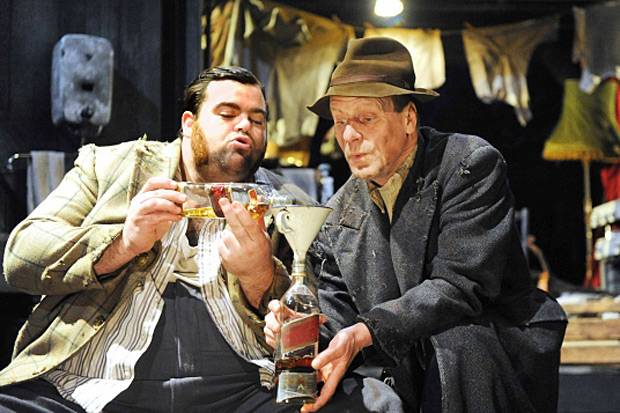
Unfortunately the same could be said of Kneehigh’s production of Steptoe and Son. The show consisted of 4 short performances, in keeping with the episodic format of the classic version, and each one touched on central themes of the father-son relationship that underpins the whole drama. The Offer touches on the bittersweet bond between father and son, as Harold bemoans his lot in life, and threatens to leave the rag and bone business. This production admirably captures the underlying tension and resentment present in the father-son relationship, which the more obvious humour and light-hearted joking rests upon quite successfully. The drama was broken up throughout the show by brief dance numbers from the trio of actors, which worked well both in lightening the tone and displaying the three impressive pirouetting performers. The Bird centres on Harold’s chronic lack of success in his romantic life, and Albert’s efforts to undermine and hold him back for his own gain. Mike Shepherd’s Albert almost succeeded in relaying the dichotomy of his actions – acutely selfish and painfully tragic in equal measure – but it fell just short of what I, in my nostalgic excitement, was expecting.

In the second half, The Holiday explored similar ideas of Harold seeking to move on by booking a holiday to “Sant Morrits”, while Albert instead advocates returning to Bognor. Great use of the staging brought this particular sketch to life. This was a hallmark of the whole production, particularly of the central “cart”, which doubled as the house, the front door, the upstairs bedroom and the downstairs kitchen. Finally, Two’s Company, the longest and most developed drama. Albert returns home late one night, and after much interrogation, Harold finds that he has asked a woman to marry him. When Albert brings her to the house, Harold realises that he and she have a complicated past… This episode is Kirsty Woodward’s real chance to shine, having been more or less non-speaking in the previous three, and she delivers a successful performance as Albert’s fiancé. This is probably the greatest example of the self-destructive nature of the father-son connection, and the best-constructed episode of the whole performance. All in all it is a solid attempt at capturing the Steptoe and Son legacy, but listening to Harry H. and Wilfrid while devouring a minimilk it ain’t.

Finishes tomorrow, more information here.

Written by a Thoroughly Modern Man, James Bomford.

THOROUGHLY MODERN MAN: Espresso Martinis at Forge and Foundry, Camden

It was nervously that I arrived at the Forge and Foundry last week, for a dinner to launch their newest cocktail, the Espresso Martini. For a coffee-avoider such as myself, this was a relatively daunting drink, but one that slipped down a real treat, particularly after the first one.

We met for drinks before the dinner, and the barman talked us through the recipe. The cocktail is a creation of the legendary Dick Bradsell, the “cocktail king” of 1980s London. It requires one and a half measures vodka, half a measure Kalhua, and the all-important measure of fresh espresso. The source of the particular espresso used by the Forge and Foundry is as charming as it is local. George, an elderly owner of a café located a few doors down from the restaurant, has been roasting a secret blend of Arabica beans for 36 years. The roasters he uses were built between 85 and 100 years ago, and luckily he can keep them in perfect working order, given his training as a mechanic in earlier life. Every day, he wanders down to the Forge and Foundry, and has coffee with the barmen there, and of course tinkers with the machines, offering advice on the coarseness of the grind, and the amount of water required.

The cocktail itself is surprisingly smooth, and despite not being a coffee aficionado, I found myself really warming to the espresso bitterness that perfectly complemented the smoothness of the vodka and the sweetness of the Kalhua. The second, and third went down even more nicely, and each glass was met with sounds of approval from all round the table.

The dinner itself was average, unfortunately, and didn’t quite live up to the promise of the cocktails. The gourmet ploughman’s platters were solid but rather uninspiring, with the Blacksticks blue cheese and Keens mature cheddar proving to be the highlight. The honey-roast and Parma hams were everything you would expect, and nothing more. For the main course, I chose the duck breast, served with an orange sauce, cocoa powder and plantain chips. The duck was a little overcooked, and the plantain chips had no reason to be on the plate. Texturally they were more like casino chips than edible ones. My companions at the table opted for the sea bass, and that looked a better decision. The highlight was undoubtedly the desserts, all round the table. My chocolate marquise with vanilla cream, hazelnuts, saffron marshmallow and strawberry sauce was divine, and the pastry chef Juan Pablo really impressed with his other offerings of Tocino del Cielo – a Spanish crème caramel dish – and the Lady Grey tea cake, with a nutty centre and wonderful “white chocolate soup”.

All in all, the Espresso Martini itself was a great surprise, and well worth a try, and the dessert section really was the jewel in the menu’s crown. Some shortcomings in the savoury offerings, however, meant that this was a slightly disappointing meal.

More information here. The Forge has just launched a new music event every Saturday called Fired Up at the Forge. With free entry from 7.30pm, it will play host to the best of new and breaking talent across the UK, focusing on live music and DJ sets.

www.foundrycamden.co.uk

Written by a Thoroughly Modern Man, James Bomford.