River Cafe, Hammersmith

As December approached last year, I found I was being repeatedly asked: ‘where is the best place for a work Christmas meal and party’? The specifications were always challenging: big enough, cosy enough, special enough, posh enough, cheap enough, private dining facilities, entire exclusivity, location… there is so much to consider, and it is a daunting responsibility to choose the venue, date and menus to satisfy the whole company.

London venues fill up fast and the prices escalate as workers all over town become more desperate for the perfect venue. This year I had my work celebrations at a very special restaurant, The River Café in Hammersmith. On a misty Wednesday lunchtime the setting was bleak and beautiful by the river. The open plan restaurant looks industrial from the exterior, slightly like a swimming baths. But inside the dining room is light and fresh with white draped tables and a psychedelic neon pink oven at the rear of the restaurant.

We were seated at the back in the lovely private dining room which seats up to 18 guests. The dining room has its own entrance with views onto the terrace and into the open kitchen. Cheese lovers will enjoy looking at the glass fronted cheese room which exhibits a selection of unusual Italian cheeses. The waiters were kind and patient with our rowdy group! We started with flutes of Prosecco, battered artichokes and pumpkin bruschetta. For starters a selection of antipasti were delivered to the table – highlights were the plump and creamy buffalo mozzarella and delicately smoky prosciutto ham.

Known for its exquisite homemade pasta, I persuaded our waiter to allow me to have a River Café pasta dish, despite its absence on the set menu. The buttery Agnoli packages of pasta filled with a rich and aromatic mix of rabbit, pheasant, pancetta, bay and Il Balzo Chianti Rufina was divine, I could have eaten double the amount. Other successes round the table were the thick-cut roast veal chop with capers, sage, lemon peel, Prosciutto di Parma and Risina beans and the chargrilled, marinated leg of lamb with smashed pumpkin & potato and hot olive & anchovy sauce. It was a feast of Italian delights.

Dessert for me was a disappointment, I found the pannacotta with pomegranate sloppy and unappetisingly presented. I looked adoringly at the plate of cheese that my neighbour was devouring. Wine was carefully and expertly chosen throughout the meal, complementing the food and flavours.

The River Café is one of the longest running, most successful fine dining restaurants in London, and I was impressed with every aspect of our experience here.
THOROUGHLY MODERN MAN: Steptoe and Son, Lyric Hammersmith

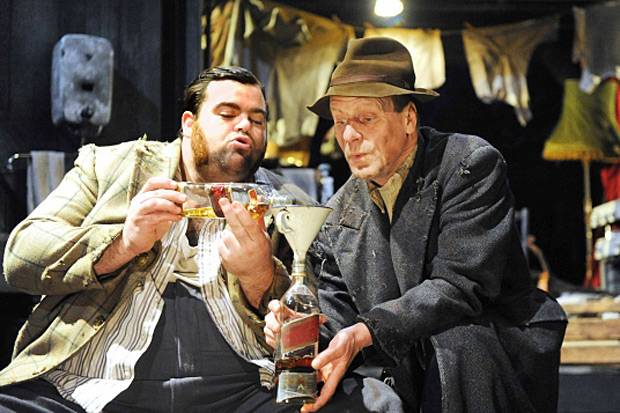
I am comfortably too young to have formed a strong attachment to the classic Steptoe and Son, first of radio and then of television fame, at their first outing, but from my childhood I have vivid memories of listening to the iconic cadences of Harry H. Corbett and Wilfrid Brambell wafting out from the radio. The show revolved around Albert and Harold Steptoe, father and son rag and bone men, the former haggard and weary, the latter watching his years drain away as his frequently self-publicised “untapped-potential” goes to waste in the backstreets of Shepherds Bush. I was too young to get the majority of the jokes, not to mention the subtler inferences and witty references, but there was something absolutely perfect about Harry H. Corbett’s denouncement of his father, at least once an episode, as “you dirty *pause* old *pause* man”, and the lilting, plaintive tone with which Wilfrid Brambell called “Oh ‘Arold!” after his son. It is as a result of this idyllic recollection that I hold Steptoe and Son up on some sort of untouchable pedestal from my childhood, alongside jumping on my bed, accompanying my dad to the corner shop on a Saturday morning to buy him papers and me and my sister pick’n’mix sweets, and minimilk icelollies. If I ever revisit such experiences, they necessarily fall short of the perceived perfection associated with them.

Unfortunately the same could be said of Kneehigh’s production of Steptoe and Son. The show consisted of 4 short performances, in keeping with the episodic format of the classic version, and each one touched on central themes of the father-son relationship that underpins the whole drama. The Offer touches on the bittersweet bond between father and son, as Harold bemoans his lot in life, and threatens to leave the rag and bone business. This production admirably captures the underlying tension and resentment present in the father-son relationship, which the more obvious humour and light-hearted joking rests upon quite successfully. The drama was broken up throughout the show by brief dance numbers from the trio of actors, which worked well both in lightening the tone and displaying the three impressive pirouetting performers. The Bird centres on Harold’s chronic lack of success in his romantic life, and Albert’s efforts to undermine and hold him back for his own gain. Mike Shepherd’s Albert almost succeeded in relaying the dichotomy of his actions – acutely selfish and painfully tragic in equal measure – but it fell just short of what I, in my nostalgic excitement, was expecting.

In the second half, The Holiday explored similar ideas of Harold seeking to move on by booking a holiday to “Sant Morrits”, while Albert instead advocates returning to Bognor. Great use of the staging brought this particular sketch to life. This was a hallmark of the whole production, particularly of the central “cart”, which doubled as the house, the front door, the upstairs bedroom and the downstairs kitchen. Finally, Two’s Company, the longest and most developed drama. Albert returns home late one night, and after much interrogation, Harold finds that he has asked a woman to marry him. When Albert brings her to the house, Harold realises that he and she have a complicated past… This episode is Kirsty Woodward’s real chance to shine, having been more or less non-speaking in the previous three, and she delivers a successful performance as Albert’s fiancé. This is probably the greatest example of the self-destructive nature of the father-son connection, and the best-constructed episode of the whole performance. All in all it is a solid attempt at capturing the Steptoe and Son legacy, but listening to Harry H. and Wilfrid while devouring a minimilk it ain’t.

Finishes tomorrow, more information here.

Written by a Thoroughly Modern Man, James Bomford.

THOROUGHLY MODERN MISS: Salad Days, Riverside

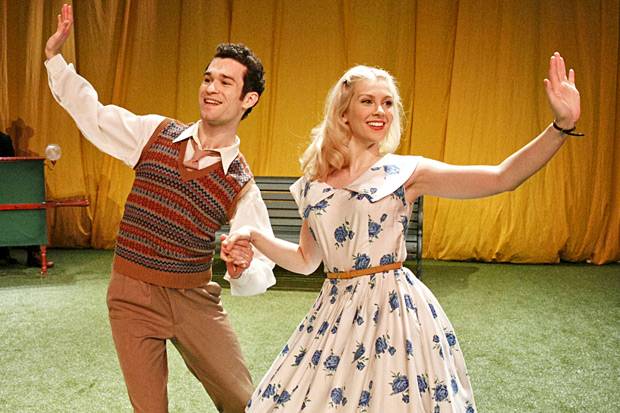
After a hearty burger at the Riverside Studios buzzy restaurant, we make our way into the main studio and are greeted warmly by a professor who hands us our degree scrolls and congratulates us on our hard work – we’ve just passed our finals! As we walk across the grassy stage/quad to our seats it becomes clear that we have just arrived at our graduation ceremony – and soon the show is in full swing with a wonderfully silly “The Things That Are Done By A Don”, a flurry of caps and gowns, and camp.

What follows is a couple of hours of joy and fun, both ridiculous and irresistibly charming. The plot is absurd in the extreme: a tramp bequeaths a piano (named Minnie?!) to a couple of recent grads, Jane and Tim,  for a month, whilst he takes a little holiday. It emerges that when played, Minnie, the piano, provokes uncontrollable dancing in all within hearing distance. Meanwhile, our two leads decide to get married, to assuage Jane’s mother  (Jane’s degree leads not to the workplace but the altar in this pre-feminist era) and start busking to fend off pressure from Tim’s mother to find a job with one of four influential uncles.  Along the way the couple pick up a bevy of colourful friends, including a sweet mute Troppo (Lee Boggess) who is devoted to Minnie and the wonderfully posh and blustering Lord Nigel (Luke Alexander) as well as a few enemies including PC Boot and a government minister who wants to seize Minnie and put a stop to the dancing. It’s worth noting this resume simplifies the story significantly; suffice to say there is a scene in a flying saucer  – in fact, it’s so bonkers that we agreed that if you tried to pitch it as a storyline to a producer these days, you’d probably be dispatched to the nearest funny farm.

The play is set firmly in the 1950s and the company embraces this wholeheartedly, with the girls prettily preened and petticoated and accents all prim and proper and perfectly pitched, in the “I-say-that’s-orfully-sweet-of-you” mode.

It’s wholesome and also hilariously naughty in parts, with lines such as “I suppose people are constantly bumping in London!” and “Batter me, shatter me, break my anatomy,” illiciting titters from the more immature among us.  The Carry-on campness of a clownish seduction at the beginning of Act II, where Asphynxia (Kathryn Martin), the singer in Cleopatra’s Nightclub, flounces and poses in full Egyptian garb like an over-sexed Patsy from AbFab, had us all in stitches. Similarly funny is the scene where Jane shows the feckless Nigel that “It’s Easy to Sing” when he sings after them: it perfectly highlights the kind of daftness that is particular to English humour.

However it’s the gorgeous quirkiness and attention to detail in this production, which really marks it out as something special in a world of commercial, pre-fabricated West End productions. From the scrolls handed to the audience at the start, to a baby’s leg doing high-kicks out of it’s pram in a dance section, everything is fastidiously considered. Evidence of this is also seen in the beautifully choreographed numbers such as the “Find Yourself Something to Do” breakfast scene, gloriously and thoughtfully directed by Bill Bankes-Jones and Nick Sutcliffe. It’s also worth saying that the live band are integrated perfectly into the show, interacting with the performers in a few scenes, particularly the twinkly fingered pianist Anthony Ingle.

We arrived feeling somewhat glum and chilly on a cold January day, and left feeling joyous, warm and ever so silly!

Continues until March 2nd, book here.
Written by a Thoroughly Modern Miss, Justine Thyme.