Alighiero Boetti, Tate Modern

There is no end to Alighiero Boetti’s imagination… weird and wonderful. This retrospective runs in tandem with the Yayoi Kusama… both are thoroughly worth a visit, a rare double whammy at Tate Modern.

Boetti was born in Turin in 1940 and moved to Rome in the early 1970s, but he spent substantial periods travelling in Afghanistan and elsewhere. The artist is perhaps best known for his involvement in Arte Povera, an art movement in Italy at the end of the 1960s when artists took a radical stance against established institutions. The work shown in this retrospective is diverse including constructions, drawings, paintings, embroidered maps and other strange creations. There is a touching sense of narrative behind every piece of work, and though many pieces seem completely random there is a thought process that unites the whole collection. The exhibition begins chronologically but later rooms are grouped according to type and idea and visitors are encouraged to decide their own route around.

I found the constructions whimsical and occasionally ominous… in one sculpture Boetti even predicts his own death date. In another room a box, Lampada Annuale, is the main attraction – inside a giant lightbulb is programmed to light up for only 11 seconds once in a year… you can imagine how each visitor wishes to be one of the special few to witness this illumination… Boetti teases the audience, I couldn’t help stay in the room a little longer… just in case.

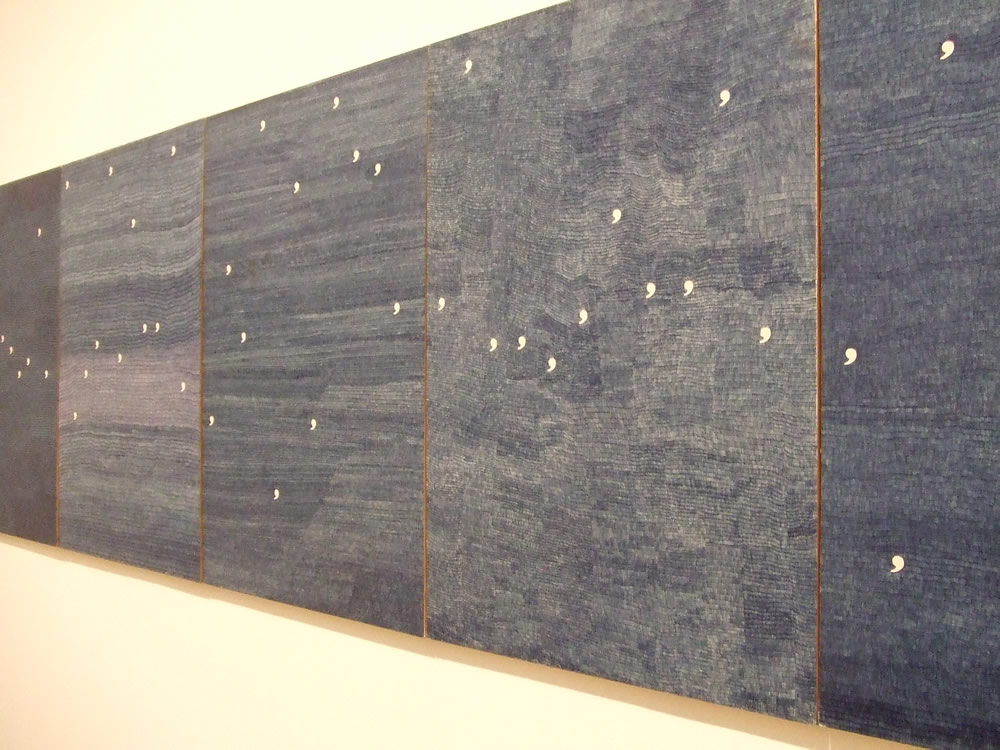
My favourite room by far is dedicated to his biro drawings. The phrase ‘Mettere al mondo il mondo’, which translates to ‘Bringing the world into the world’ appears in the biro works, a working principle for Boetti. In 1971 the artist began covering large sheets of paper with biro ink, carefully drawing each individual line to create a wave of movement. After a while he began delegating the work to teams of students in Rome. Commas are shown where the ink stops to reveal the shape on untouched white paper. The commas look like lonely stars within the depths of intense blue ink, they are beautifully calming and a testament to the time and patience Boetti dedicated to his work.

The final rooms exhibit the huge embroidered maps, another time consuming feat. I found these less captivating, though could appreciate their obvious beauty and epic scale. For these works Boetti worked with Afghan weavers in exile to produce technicolor maps of the world. They are by no means representational (in one the sea is shown in pink!) but present an individual’s vision of the world.

Alighiero Boetti was a mysterious man… this thought provoking retrospective gives a little insight into his tantalising world.

Continues until 27 May, book here.
Yayoi Kusama, Tate Modern

 A trip to Tate Modern begins with a trail of orange lampposts from Southwark tube station. At the Yayoi Kusama exhibition the colour continues with an explosion of bright psychedelic pattern and shape. It is about time that Japan’s best-known living artist received a respectable show in London.

Observing this amazing document of her life, it is clear that Yayoi is one hell of a character. Her vast output is vibrant and exciting, immensely dynamic and unlike any other. Her life long obsession with polka dots and the infinite is evident in her whole body of work. Following her comfortable upbringing in Matsumoto City in Japan where she began creating art, she moved away from a culture she found increasingly claustrophobic and towards the inviting big wide world.

Now aged 82, she is as prolific as ever but is confined to a wheelchair, proclaiming “I have done all the work myself, not assistants. That’s why I’m in a wheelchair”. Living in the mental health hospital she admitted herself to in 1970, her life is anything but conventional. Building herself a studio across the road she has commuted daily between locations ever since 1977.

At Tate Modern fourteen rooms display Yayoi’s sculptures, paintings, and videos from the 1960s to today. Her early paintings bear the direct influence of her native environment and upbringing in Japan. She studied the conventional style of Hihonga painting, and her images depict natural imagery. These pictures interestingly offer clues to her later more eccentric use of pattern and shape.

The phallic shape is a recurring motif throughout the exhibition, evident in her very first room installation from 1963, Aggregation: One Thousand Boats Show. A white painted, fabric phallus-encrusted rowing boat sits illuminating a dark room, the walls, ceiling and floor are covered with black and white posters of the same boat. It is very odd experience, the repetition and graphic qualities are reminiscent of the pop art movement.

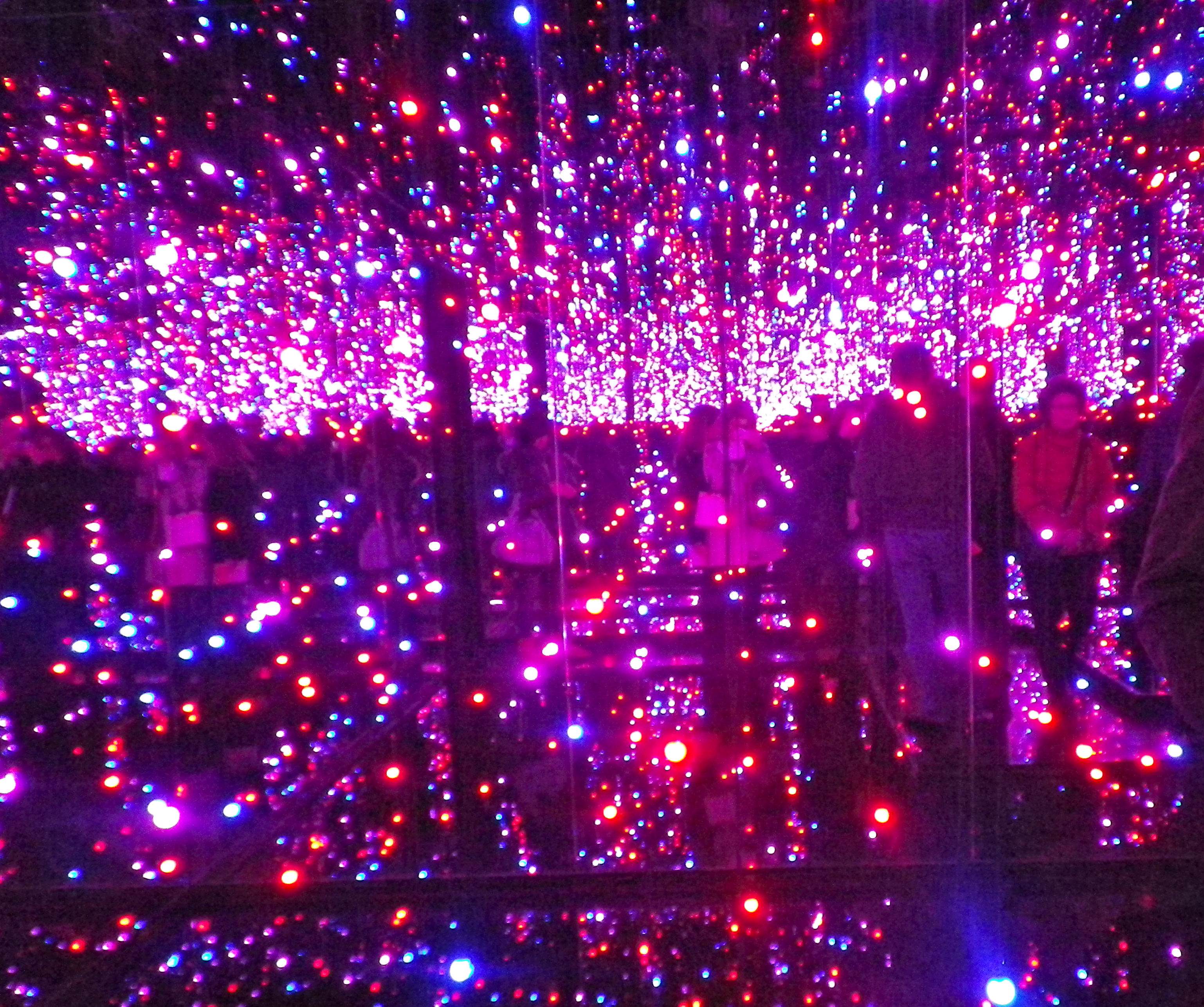
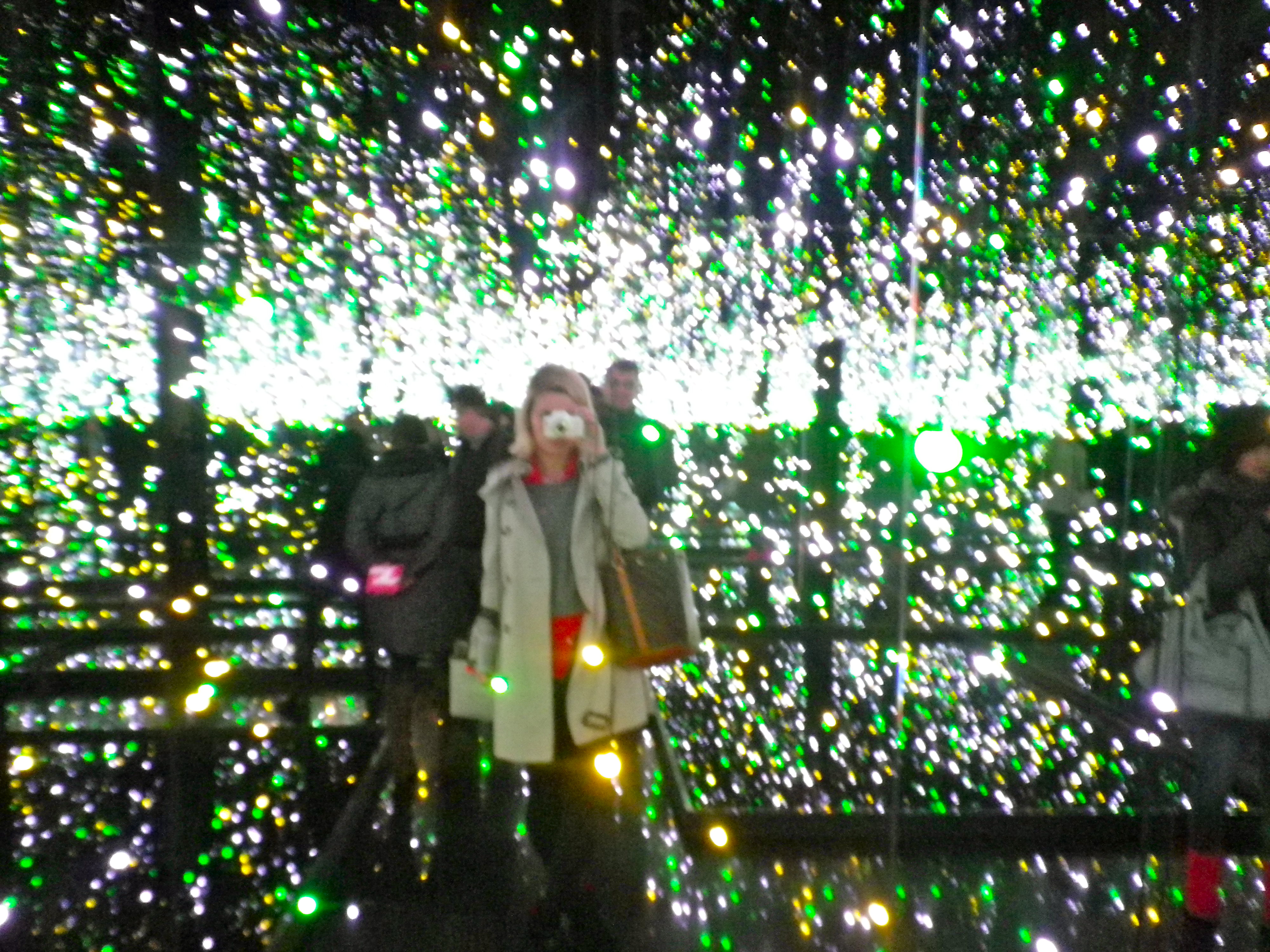
The rooms sparkle gloriously, inspired by hallucinations, they are overwhelming, a never-ending sea of flickering lights, and bright specks of colour that are hypnotic in their beauty. Visitors are warned before entry that they may find the Infinity room unsettling and confusing. I thought the effects were magical and utterly entrancing.

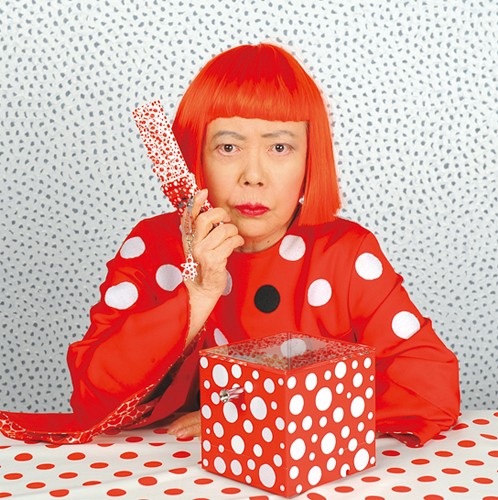
Yayoi is not the only polka star in the art world, an obvious comparison is of course Damien Hirst and his obsessive spots which are currently on show in every branch of the Gagosian Galleries. Spots are the common theme running through her output, in her earliest works as a symbol of love and peace, in the most recent disorientating rooms, and in a dimly lit white room with fluorescent stickers everywhere, even in the clothing she wears.

I had great fun downstairs where a white room has been decorated by visitors with multi-coloured different sized spots, Yayoi inspired décor. The guard on the door handed me, what was apparently the last sheet of stickers and I went round finding suitable places for my contribution to the artwork. The effects are eerily similar to Yayoi’s mad creations upstairs.

A polka dot extravaganza awaits you…

Continues at Tate Modern until 5 June, more information and book here.