THOROUGHLY MODERN MISSY: The Girl of the Golden West by Puccini, ENO

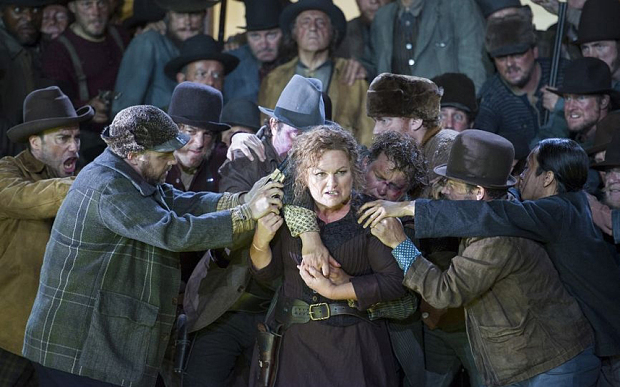
To think of Puccini’s operas is to be transported to the Orient, the Latin Quarter of Paris and to Rome. But when the curtain at the ENO was raised on the scene of a bar in the middle of Goldrush California, the audience stirred in their seats. When a cast of nearly 40 males crowded onto the stage moving with slick gun-slinging choreography and excellent solo performances, the audience were thrilled and carried away by the story. And when Susan Bullock, the ENO’s new Minnie in The Girl of the Golden West made her powerful entrance onto a stage crammed full of hearty male voices, the audience were entranced by her authoritative and formidable voice. Needless to say, this was not your typical Puccini performance. The last ENO performance of this lesser known opera of Puccini’s was over 50 years ago and the performances, direction, set design and general production proved to be well worth the wait.

Richard Jones’s direction introduced a fresh take on the dusty setting of Goldrush California and created nuances that one is surprised to see on an opera stage. For example, the decision to start Puccini’s rapturous opening to the opera with the curtain down but brilliantly illuminated, creating an air of anticipation before the big reveal of the somewhat bare and ever so slightly contemporary bar scenario. The set could have been inspired by the trendy ‘Scandi’ aesthetic of simple lines and bare wood with strip lighting accents. The set changes with each of the three acts and the third set, which acts as the backdrop for the nail biting finale looks like a 3D Hopper painting with a long cuboid Sheriff’s cabin which the audience looks in on as if eavesdropping. The simple yet effective design refreshes the Western soul of the opera and provides a bland enough backdrop for the tumultuous singers and storyline to shine.

Though some think that the opera’s less popular reputation is deserved since Puccini neglected his famous and standalone arias in favour of illuminating the drama of David Belasco’s libretto, much of the music can still sweep one away. (Whether this is due to the excellence of the singers, you will have to decide for yourself!) Personal highlights were the soaring ‘Quello che taceto’ performed by British tenor, Peter Auty, playing the part of Dick Johnson, which could rival most other Puccini arias (and also, it seems, Andrew Lloyd Webber’s Music of the Night from his Phantom of the Opera). Another highlight was the seduction scene between Dick Johnson and Minnie, very amiably and wittily observed by the only other female cast member, Clare Presland.

Yet another original feature was the modernity of the production; the opera was well translated into English by Kelley Rourke and the line ‘would you like a cookie’ was enough to keep this production in the 20th, if not the 21st Century. There is modernity too within Puccini’s opera itself. To have a strong female heroine who has conviction enough to wait for whom she loves (even if he is a good-fer-nothin criminal), and also confidence to stand up to 40+ miners is still a peculiarity in the opera world. Susan Bullock thrives in this role and adds humour and sensitivity to the part – every inch a Thoroughly Modern Minnie.

The production in general is a triumph, and considering that for many of the cast and crew this was a UK debut, one can only see the result as a shining testament to their professionalism and talent. Keri-Lynn Wilson echoes the strong female role in the orchestra in her UK operatic conducting debut and American Craig Colclough makes his European and role debut as the unpleasant and rejected Sheriff Jack Rance. It is also worth noting that both Sonora (Leigh Melrose) and Larkens (Nicholas Crawley) stood out from their strong chorus. The ENO’s The Girl of the Golden West is truly memorable and a thrilling success. Do go see it and avoid the next 50 year wait!

Continues until 1 November, book tickets here.

Written by Thoroughly Modern Missy, Angelica Bomford.
The Pearl Fishers, ENO

I spent much of my fifteenth year rehearsing and performing Bizet’s Carmen at the Royal Albert Hall, so I was very ashamed when I realised my ignorance of this French composer’s other famous opera, The Pearl Fishers. Enlisting the help of my experienced operatic grandmother we went along to the ENO’s revival of this classical masterpiece.

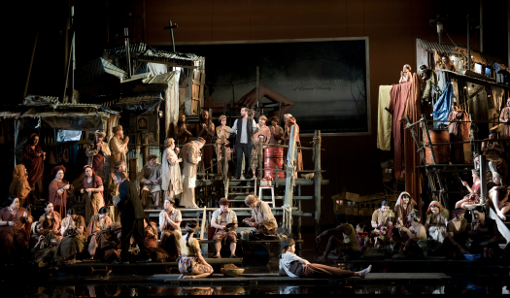
A co-production with the Metropolitan Opera in New York, this 2010 revival, directed by Penny Woolcock, is staged this season with a new, young and talented cast. Set in Ceylon (Sri Lanka), there is immediately a sense of the exotic, the rippling overture transporting the audience to a faraway scene. A semi-opaque screen shows elusive divers who dip and drift in the air magically, a sensational and seamless display of artistic acrobatics. Meanwhile gentle music floats from the orchestra pit, conducted by the very able and passionate conductor, Jean-Luc Tingaud.

The narrative is centred on the friendship of two men, Zurga (village headman) and Nadir (a pearl diver) who were previously torn apart after both falling for the same girl, Leila (Priestess of Brahma). Forgetting their feud and abandoning the girl, they reunite and remember moments from the past, singing the famous operatic friendship duet, “Au fond du temple saint” (The Pearl Fishers Duet). When Leila unexpectedly arrives, disguised as an unknown priestess. Nadir recognises his lover’s voice and they reunite late at night; found together, they are sentenced to death by Zurga who is devastated by the betrayal. A revelation from the past saves the lovers lives but risks Zurga’s future.

We were notified at the start of the show that the leading lady, Sophie Bevan had been struck down with a sickness bug, which the ENO casting director kindly explained in graphic detail! Bevan bravely came on and sung with a shrill and bright tone, delicately negotiating the intricate runs. John Tessier is a young and spritely tenor with a light, bright and clear voice, though we were less impressed with George von Bergen as Zurga, whose wobbling bass could not cut through the swelling orchestra, his acting however was the most believable of the group.

The orientalism is often confused, costumes vary from Leila’s belly dancing outfit to Nadir’s Aussie surf shorts look! The set however is wonderfully evocative, a rickety Sri Lankan slum, crowded with chorus members draped in rags. Set Designer Dick Bird also creates a memorable Library backdrop for the final act. Despite the lack of water on stage, the aquatic environment is represented with varying effects and materials, all of which I thought were very successful and stunning to watch.

However just as we arrive at the happy ending, the couple reunited and running off into the sunset, the audience are confronted with a horrific vision of dying children, carried in after the village fire, an unnecessarily bleak finale in my opinion.

Continues until 5 July, book here.

The Tales of Hoffman, Oslo Operahuset

Oslo Operahuset is perhaps the most impressive piece of architecture in Norway’s capital city. Sitting precariously on the water’s edge, this bold, jagged glass and marble structure is admired for its glacier-like appearance and beautiful oak-lined auditorium. Designed by architects Snøhetta, the opera house was completed in 2007, ahead of schedule and under budget. Since opening it has received various awards and accolades and is also the home to two fine restaurants, Brasserie Sanguine and Argent Restaurant.

Visiting the opera house on New Year’s Eve, there was an air of excitement and anticipation in the foyer. This production of The Tales of Hoffman is extravagant and dramatic. The show was perhaps the most visually shocking and impressive I have ever seen. Offenbach’s only opera is often mistaken for a fairy tale for children; this production showcases it as quite the opposite, ‘a grotesque-romantic portrayal of an alcoholic poet fleeing from the realities of life’. Wildly modern, almost futuristic in style, this rendition, directed by Per Boye Hansen aims to thrill and disgust.

The acoustics are startling in the grand auditorium, every note is crisp and clear, projected to the very furthest corners of the theatre. Despite the nonsensical storyline, I felt captivated throughout – the realisation of this crazy tale is striking and memorable. There are some magical moments, both technically and emotionally… particularly memorable perhaps is the live white dove on stage, who seems to appear from the body of the dying woman, Giulietta.

Pulling off this show is a great feat and the cast truly excel, immersing themselves entirely in the messed up dreamworld of Hoffman.

I highly recommend a visit to this spectacular opera house, the building is beautiful and the productions completely mesmerising.

More information and book to see an opera here: operaen.no

Many thanks to Oslo Tourist board for their help with this trip. More information here.

www.visitoslo.com

www.visitnorway.com/uk