THOROUGHLY MODERN MISS: Someone to Blame, King’s Head

Reading about Someone to Blame weeks before I saw it, I knew that it could be a play I would never forget. Although this remains true, the production itself isn’t the reason it will haunt me, it’s the subject matter.

Sam Hallam was 17 when he was arrested and charged with the murder of Essayas Kassahun. Essayas was killed by a gang in Hoxton when he went to the aid of his friend Louis. Tragic though this is, he was not the only one to lose his life that day.  Sam was found guilty of murder, despite the fact that he, and several other witnesses, asserted that he was not even at the scene. The prosecution evidence was fundamentally flawed: it consisted of two eye witnesses, one who retracted his statement in court and the other that admitted she had just been “looking for someone to blame.” And yet the jury still sentenced him to life imprisonment.

That was 7 years ago. Since his arrest, Sam’s family and friends have never doubted his innocence, mounting a campaign to appeal his guilty charge. On 16th and 17th May 2012, Sam will have his second appeal hearing, possibly his last chance for freedom. Writer, Tess Berry-Hart, used transcripts from the court case and interviews with family and friends to write Someone to Blame, a word for word account of the incident.

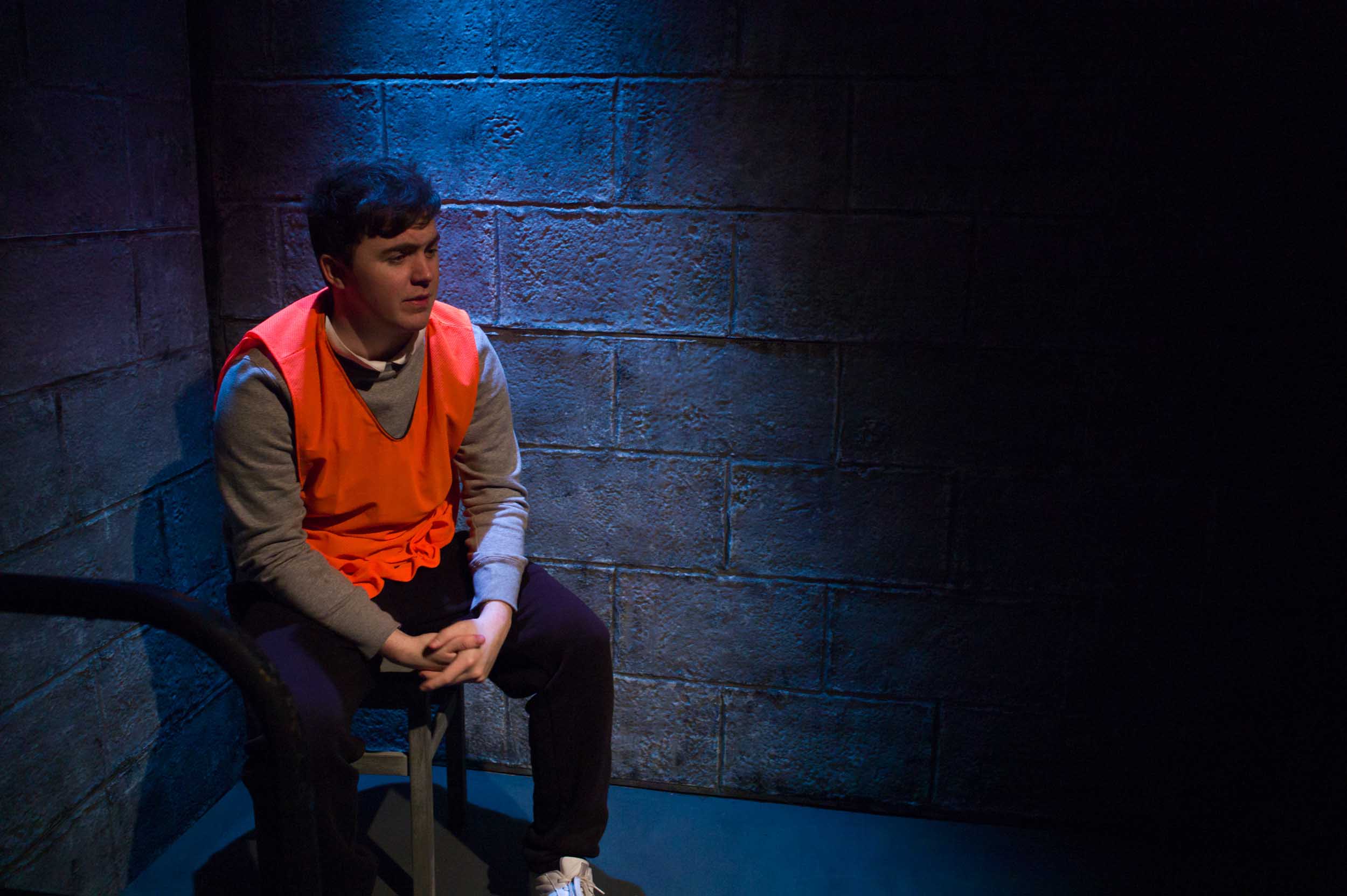
A story like Sam’s clearly lends itself to drama and Someone to Blame doesn’t lack in that department. The actor playing Paul May, the lawyer appealing the case, restlessly narrates the entire story from a stool in the corner of the stage. Although many of his insights into the case are useful, he often interrupts the flow of a scene with overcomplicated and condescending explanations, which seem to labour the point.

The fact that the script is completely verbatim is one of the great selling points of the production because we know we are getting an accurate account of events, or rather, accurate from one very specific viewpoint. But consequently, the script feels disjointed and episodic in parts. The best scenes were the ones in which characters were allowed a lengthy period of interaction, such as the court scenes, which felt more like a play and less like a law lecture.

Robin Crouch’s Sam was very good; he evoked sympathy and admiration without appearing desperate and unexpectedly took a back seat to many of the other more sensational characters.

Unsurprisingly, the production couldn’t quite strike the balance between art and reality; it was clear throughout that I was watching a campaign advertisement. No more so than at the very end, when Sam’s friends warn the audience that injustice could just as easily happen to us, even people who “live in a million pound mansion in Knightsbridge”. In a style strikingly similar to Niemöller’s anti Nazi poem, May then warns us, almost threateningly, that if we don’t support Sam now, one day it could happen to us and then who could we ask for help?

There is no doubt that Someone to Blame is promoting an important cause and one that I am now invested in, as I’m sure many other audience members are. Although at points lacking in depth and flow, it was a shocking example of incredible injustice with truly tragic consequences.  That’s what we’re supposed to believe, anyway.

Someone to Blame continues until 31 March, more information here.

Written by Thoroughly Modern Milly, Jenny Greenwood.

THOROUGHLY MODERN MAN: The Mikado, King’s Head Theatre

This was a night of firsts for me: my first visit to the Kings Head Theatre in Islington, which I had heard so much about; my first time watching (ashamedly!) a Gilbert and Sullivan production and; my first time reviewing solo without the company of one Thoroughly Modern Milly!

Each of these novel experiences lived fully up to expectation as I was thrilled and entertained by Charles Court Opera’s intimate version of The Mikado in the warm (literally!), inclusive atmosphere of this fringe venue. The quick witted and sparky action of this production kept the audience constantly engaged while the actors bounced off each other with lightning quick reactions. John Savournin’s choreography made creative use of the small space he was confined to, and suitably complimented the fine singing. The stars of this show were the comic counterparts Pooh-Bah and Pish Tush, acted out superbly by Savournin and Ian Beadle respectively. These men sang with impressive resonance and acted with a very clear awareness of their characters’ motivations. Also worthy of mention is Catrine Kirkman’s Yum-Yum, who sang with admirable clarity, control and poise in her famed aria ‘The sun whose rays are all ablaze’. I also take my hat off to Nichola Jolley, whose comedic interjections as Pitti-Sing were perfectly timed, and communicated with the most captivating and amusing facial expressions.

Aside from the action, the pianists, David Eaton and James Young, played with remarkable dexterity and sensitivity. It is some task for four hands at one keyboard to be responsible for accompanying this entire tour de force, and this duo deserves the highest praise for the skill and gusto with which they fulfilled their role.

I was fortunate enough to catch this production just before it closed but never fear! Charles Court Opera will return to The King’s Head in September with what will no doubt be an innovative and spunky production of The Pirates of Penzance. This burgeoning young opera company is certainly one to watch. I must insert a health warning at this point though: the wine served at the King’s Head is very drinkable and the craic is mighty – DO NOT MISS YOUR LAST TUBE HOME! (Not that this happened to me of course…)

Written by a Thoroughly Modern Man, Mark McCloskey.

THOROUGHLY MODERN MAN: The House of Bernarda Alba, Almeida

The Almeida Theatre in Islington, an equidistant ten-minute stroll from Angel and Highbury and Islington tube stations, is a gem amidst the buzz of this vibrant North London area.  The interior design reflects a modern twist on an almost Victorian style gallery, with a sharp vertically rising seating arrangement, and an ample stage that invites the audience in most intimately.

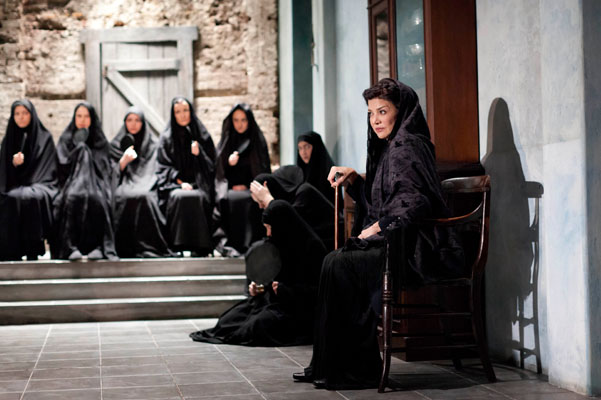
Gracing the stage until mid-March is Federico Garcia Lorca’s chilling tale, ‘The House of Bernarda Alba’, revamped somewhat by Emily Mann.  Subtitled by the original playwright as ‘a drama of women in the villages of Spain’, the play centres on the events of a house in Andalusia during a period of mourning, in which the protagonist wields tyrannical control over her five daughters.  The plot is driven by the effective use of an unseen character, a local bachelor, Parvis Romany, who seeks out the eldest daughter for her wealth, but the youngest daughter for her beauty.  What follows is a dramatic crescendo towards a shocking denouement, laced with themes of lust, jealousy, rebellion and sibling rivalry.

The undoubted star of the show is Oscar-nominated Iranian-born Shohreh Aghdashloo, who shines as the eponymous Bernarda, depicting a winning combination of pride and venom that engages and repels the viewer in equal measure.  Standing strongly opposite her is the wonderful Jane Bertish as servant Darya, who delivers a commanding performance of great integrity.  For the briefest of comedic interjections, Jasmina Daniel’s portrayal of the elderly mother Amina is also worthy of note.

Bunny Christie’s set is flawless, making efficacious use of the Almeida’s stage to transport the audience back to rural 1930s Spain.  My one pernickety observation of Mann’s modernisation is that Bernarda is the only character to speak with an authentic Spanish accent, which, against the others chattering in a Queen’s English, seems slightly illogical.

At £9 a ticket for good circle seats, this is most certainly a bargain to be exploited.  Disclaimer: you may leave the building feeling marginally disturbed, but nonetheless moved.  ‘The House of Bernarda Alba’ plays at the Almeida Theatre until 10th March.

Written by a Thoroughly Modern Man, Mark McCloskey.