THOROUGHLY MODERN MAN: Hedda Gabler, Old Vic

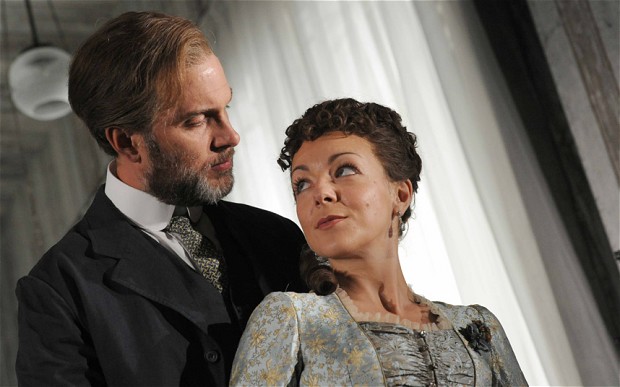
Prior to attending the press evening for this production, I had been walking past the Old Vic on an almost daily basis and salivating at the thought of seeing Sheridan Smith taking the reins as the eponymous Hedda Gabler.  On all fronts, the night entirely lived up to my expectations.  At almost two centuries old, the Old Vic Theatre is the perfect establishment to play host to Ibsen’s masterpiece, which dates back to a badly received premiere in Germany in 1891.  A 1901 run on Broadway soon changed opinion, however, and the play continues to be performed on stages across the world.

Entering into the auditorium, one is initially struck by Lez Brotherston’s exquisite set.  While light and ornately furnished, the layout also effectively achievs the growing sense of doom that ultimately traps the protagonist.  Smith’s opening and closing of the drawing room doors is a symbolic and meticulously studied act throughout the performance; regardless of all else that is going on stage –she holds the attention of the house at these junctures.  In addition to the wonderful design, there is the extremely clever use of incidental music to both build and ease tension.  This, in combination with the actors’ perfectly timed dialogue and actions, provides for a very gripping spectacle indeed.

To state the obvious, Smith steals the show in her leading role.  Her portrayal is an intoxicating tour de force that invokes a combination of dislike, admiration, disgust, admiration and ultimately horror.  The crescendo towards the horrific denouement is paced remarkably well as she descends into her frenzied internal inferno.  I could wax lyrical about the entire cast but I will give only a few special mentions to my particular favourites.  Adrian Scarborough as George Tesman very much complimented Smith as the rather cumbersome and tactless oaf with a heart of gold.  That said, he was well able to rev into ‘serious mode’ when the tempo demanded it.  Darrell D’Silva took on the role of Judge Brack, whose relationship with Hedda exposes more of her shortcomings than she would care to be open about.  D’Silva achieved the right balance of an outwardly amicable gent with a tendency towards malice when required; his asides with Smith were some of the most engaging of the evening.  Finally I must commend Anne Reid for her evocation of Juliana Tesman. One of the ‘goodies’ of the cast, Reid’s acting was wonderfully innocent and warm-hearted; a perfect counter-balance to the undercurrent of menace that pervades the play.

I could go on, but I really feel this is a stage sensation that you must experience for yourself.  The run continues for a relatively limited period, ending on the 10 November.  Book now or forever regret missing out!

Written by a Thoroughly Modern Man, Mark McCloskey.

THOROUGHLY MODERN MISS: A Doll’s House, Young Vic

Spoiler alert! (I’ve always wanted to write that!)

Warning – do not go and see this if a) if you are going through or have just gone through or are even considering a break-up b) if you are feeling remotely emotionally rickety.

Milly and I had the spectacular good fortune to see A Doll’s House last night at the Young Vic Theatre and were treated an epic evening of the finest theatre. It is a whirlwind beginning with the stage revolving at speed while Nora (Hattie Monahan) sweeps in, laughing her way into her small but perfect home laden with Christmas gifts. We watch as Nora sneakily scoffs chocolates like a naughty little girl behind her husband’s back. Then she alternates between childlike wheedling and turning on the sex appeal to squeeze a few extra Kroners out of her hubby.

This opening scene tells of a complicated symbiotic relationship between Torvald and Nora, he, repeatedly belittling his “little hamster” one minute then idolizing her the next,  whilst she gladly plays the submissive wifey, agreeing to dress up and sing for him, revelling in the almost suffocating attention. This is the status quo in the Helmer household and sickly sweet and unequal as it is, this kind of relationship is utterly recognisable (albeit infuriating) to a modern audience: how many of us have seen our girlfriends (or ourselves) regress to giggling idiots to please a certain kind of man?

Into this cloying nest comes an old school friend of Nora’s, Kristine (Susannah Wise), recently widowed and looking for a job. In the face of Kristine’s misfortune and subsequent self-reliance, Nora seems ever more childish, vain and spoilt. She is wildly jittery and overwrought, all wide-eyes and fluttering hands. You feel like walloping her as she manages to hijack every conversation and displays the sensitivity of Stalin in the face of her friends’ suffering. Later she confesses to having borrowed a huge sum of money without her husband’s consent to pay for a year away in Italy in the early days of their relationship.

This secret forms the crux of the play, and is partly responsible for Nora’s anxiety which worsens when the disgraced loan shark who leant her the cash, Krogstad (Nick Fletcher) turns up. He threatens to expose her to her husband both as a liar (she had said her father leant her the money) and guilty of forgery (she copied his signature- silly girl) unless she intervenes on his behalf. Krogstad is played with reptilian coolness by Fletcher, a man driven to seek justice and to work his way up in society after making a similar mistake to Nora’s many years before.

The pressure mounts on Nora as she wracks her brain to resolve the mess she has made and relieve the guilt that she feels living under the shadow this secret. After a particularly self-righteous diatribe by Torvald about how “lies in the family home disease the place”, Nora is literally left reeling, and so are we as the stage spins and spins, like Nora’s mind.  It’s then that she falls into the arms of the Helmans’ best friend, the ailing Dr Rank, who also loves her and whom, to her credit, she refuses to take advantage of in her distress. As the lights go down in the fist half, we watch Nora dancing the Tarantella to distract her husband and numb herself- “ You’re dancing as though your life depends upon it” he tells her, and the whole world of the play seems to shudder with her as she dances and the lights flicker to darkness.

Watching a show this good comes with it’s risks, one is the extreme tension with which you are left as you are dispatched into the foyer for the interval,  dying for a swift slug of white wine and a deep drag of nicotine. This seems tame compared to the almost catatonic shock that you feel at the end of the play, when Nora, eyes finally opened to the emptiness of her previous existence and relationship, severs her nine year marriage to Torvald and sets off into the night and a future unknown. This scene, coming as it does just as things appear to have resolved themselves is one of the most brutal of break-ups I’ve ever witnessed onstage or off. It is almost unbearable to watch as Nora, tells her husband that he is a stranger to her – she sounds as though she is choking on the words, gulping at the air around her, her pain palpable. As she declares “You must never write to me. You must send me nothing…” you can almost hear her saying “No email, no texts, nothing”, such is the relevance and universality of the moment.  And you almost feel sorry for Torvald too, a man so out of his depth in the face of his wife’s resolve that you can feel nothing but pity for him, despite his atrocious treatment of his wife only minutes earlier. Every feminist feeling in the room reaches out to Nora in support and it seems impossible that Ibsen never meant for this play to have a feminist message.

It also offers fantastic highs, some in the most unexpected places, not least when a live, plump baby arrives onstage mid-show has every woman in the place uncontrollably “aahing” and clucking! Yolanda Kettle is perfection as the Helmer’s long suffering maid Helene, tasked with heaving around Christmas Trees and averting her eyes tactfully in the face of some serious PDAs! Above all the bold and brave performances given by Monahan and Rowan and Carrie Cracknell’s superb direction highlight the tragedy as well as the humour. They leave an audience shaken but grateful for having seen Simon Stephens’ wonderful version of A Doll’s House.

Continues until 4th August, book here.

Written by a Thoroughly Modern Miss, Justine Thyme.

Democracy, Old Vic

Michael Frayn is a very clever man. His plays never fail to surprise and educate me. Democracy could not be more different in tone and content to Noises Off and yet both are utterly convincing and impressive on stage.

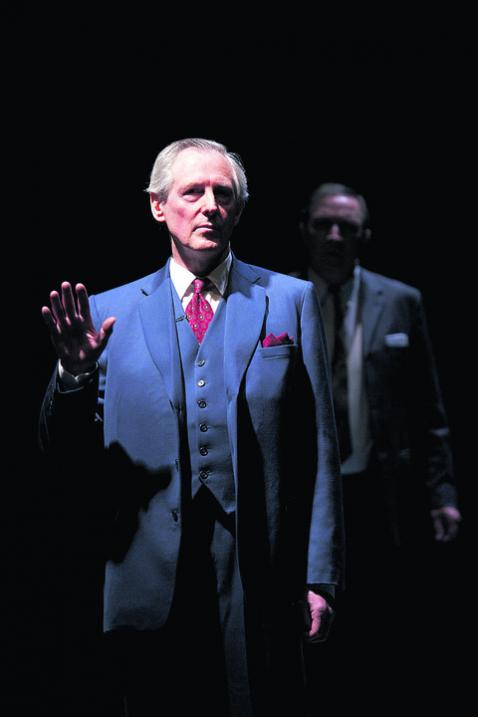
Modern German politics is a complex topic to portray in theatre, and it certainly wouldn’t usually be a subject to attract my attention. However Frayn manages to isolate a fascinating period in this country’s tumultuous history that is rarely written about. ‘Democracy’ is centred around conflict and duality, examining the important relationship between statesman Willy Brandt and his devoted assistant, Gunter Guillaume. Frayn uses these remarkable people and events to create a gripping spy thriller for the stage. The play is predominantly set in the cabinet office, the layout is rather austere… wooden desks and dimmed lighting. I was disappointed by the lack of scene changes… the strict but simple staging remains almost identical throughout the production which feels a little static.

Paul Miller effectively translates this play onto the great Old Vic platform. The all male cast mill about the stage discussing the government situation. The Stasi traitors co-exist on stage while the German Social Democrats go about their daily business. It is a strange conceit whereby one character, Arno Kretschmann remains invisible for the duration of the play. I was most inspired by the very human natural progression of characters, as the deception sets in, the relationships form and bonds organically grow between the men.

Patrick Drury is utterly mesmerising as Willy Brandt, his expressive face and poignant eye contact command the attention of the audience; I couldn’t help but stare at this charismatic man. I really enjoyed Aidan McArdle as Gunter Guillaume, he has an infectious energy on stage and truly commits to the role appearing both humble and sneaky as the spy at the centre of the story. Together these two characters forge a tender and believable working friendship and the interplay between them is the most striking element of the evening.

If you are hoping for a reprisal of the raucous Noises Off, you will be disappointed as Democracy is dry and dense in comparison. However if you enjoy striking and intelligent theatre, this play will appeal and will shed light on an intriguing and momentous part of German history.

Democracy continues until 28 July, book here.