Lucian Freud died last summer, aged 88, but the National Portrait Gallery’s grand exhibition was planned long before, and the artist himself played a vital role in its organisation and presentation. Of course, his sad passing has dramatically increased the interest in this show, and perhaps the high ticket prices reflect this. He was arguably Britain’s most talented painter, in this exhibition we see his earliest portraits alongside the unfinished canvas showing his final strokes.
Freud was a fascinating and a fascinated person, enthralled by the human body, and captivated by the human spirit. His models would sometimes sit for months and years to be painted by him. Fellow artist David Hockney sat for 130 hours for one portrait, when asked to return the favour Freud only posed for two and a half hours! Often he used those closest to him, his mother, partners, children and friends, but other sitters varied, including some very influential individuals, like the Queen! The exhibition includes a number of self-portraits which are arguably the most expressive and intriguing pictures from his output. The earliest self-portraits, like ‘Man with a Feather’ (1943) are wonderfully mysterious, though direct. My favourite is the ‘Interior with Hand-Mirror’, a small oil painting in which Freud is looking down on us, it is a more abstract portrayal – he is distant, once removed with the mirror shielding the real man.
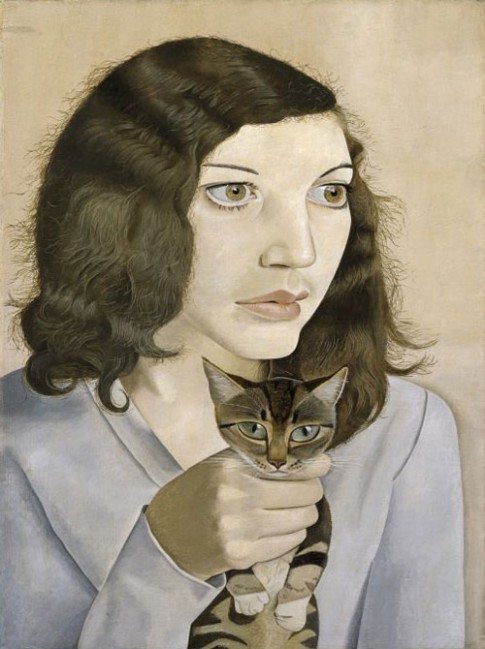
The early paintings are beautiful and still, very detailed and exact. The faces follow a formula, thin cheeks, big round eyes, vacant expressions. These portraits are organised, the sitter seems aware that they are being observed, often they carry a prop. My sister particularly liked the ‘Girl with a Kitten’, a lovely but eerie image of a wide eyed girl appearing to strangle a small innocent kitten. Here Freud used fine sable brushes to make subtle strokes, a big contrast to his later style with thick impasto and coarse brushwork.
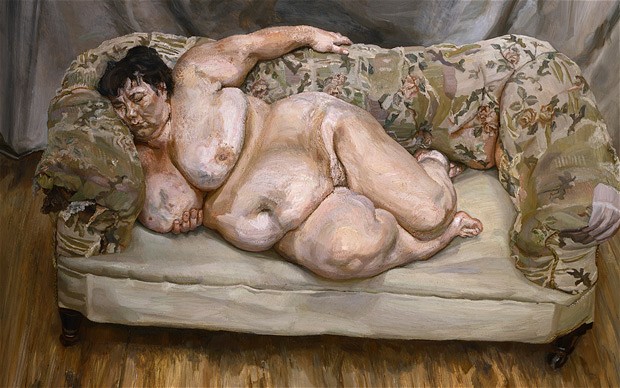
Freud seems to enjoy challenging his subjects, often his models are splayed uncomfortably on the floor or sprawled awkwardly amongst dirty rags. It is these unconventional poses that are most interesting to observe, I particularly remember the huge portraits of Sue Tilley (Big Sue), a benefits supervisor who sat frequently for Freud. The artist enjoyed her unusual proportions indulging gloriously with a huge canvas, a marked change from his earlier work. His familiar technique for painting skin tones loosely in bold colours has influenced many.
The final rooms show works created in the last twenty years of Freud’s life. They are deeply moving and intense and show a very organic connection between artist and sitter. Here we see several paintings of his assistant, David Dawson who sat for hours for Freud. It is strange that these paintings, all created in the intimate environment of Freud’s studio are now exposed to an international audience of millions, and in some ways while viewing and examining these pictures I felt I was intervening in private relationships. Though Freud’s style was constantly evolving he was always very acute in his observations, and his work forever remains sensitive and understanding.
This is an honest and vivid exhibition of perhaps the greatest British portraitist of all time. The Lucian Freud Portraits are unmissable and I predict this will be the most powerful collection of paintings exhibited in London this year.
Continues until 27 May, book tickets here to avoid disappointment.