THOROUGHLY MODERN MISSY: The Barber of Seville, ENO

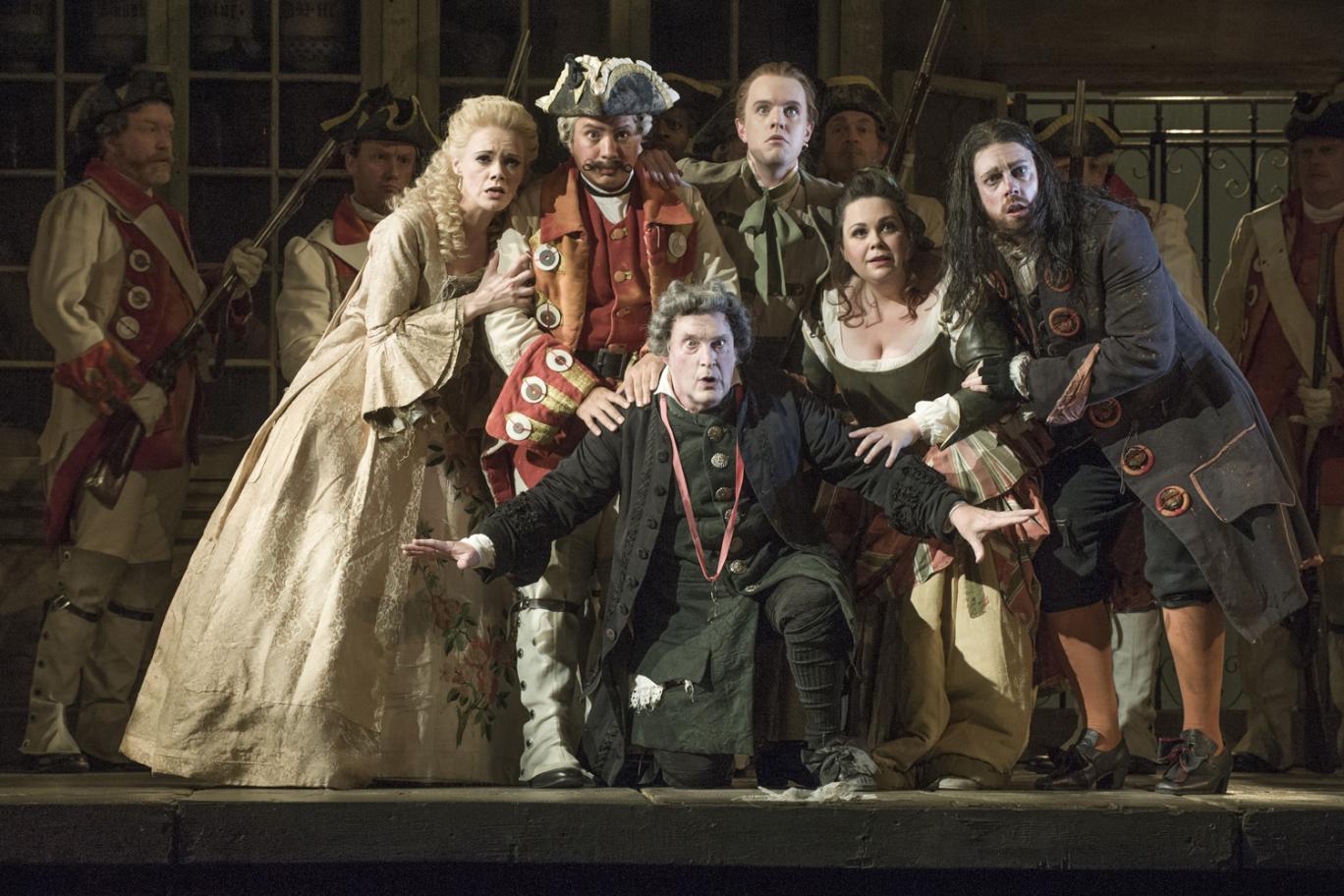
The year is 1987; Wall Street and Fatal Attraction are the blockbusters of the year, Toni Morrison’s Beloved has just been published, legwarmers and shoulder pads are still a thing, and Jonathan Miller’s much loved production of The Barber of Seville is debuted.  Fast-forward 28 years and the production still stands firm as a crowd favourite, (happily unlike those legwarmers and shoulder pads) proving that new is not always better. Rossini’s comedic yet endearing work is a cornerstone in ‘dramma-giocoso’ opera and this production continues to uphold its reputation, even if there is that initial knee-jerk reaction of feeling confused on hearing English words replacing the familiar Italian.

In a work as full of energy and activity as Rossini’s Barber of Seville, comic timing is everything and this particular cast has mastered the delicate art of well timed physical comedy. Andrew Shore showed his penchant for comedic portrayals with his scene-stealing Bartolo. Other singing highlights included Morgan Pearse as a fresh-faced Figaro who sang the famous repeated “Figaro”s with much aplomb to the audience’s delight. Kathryn Rudge, who played the bright and charming Rosina, handled Rossini’s famously fiendish runs elegantly. These singers were generally well accompanied by the orchestra, save for a few noticeable moments when the balance was not right and the voices were obscured by heavier instruments.

Miller’s gem is still definitely worth going to see, even in it’s 12th revival, and that is something to applaud (as the audience did when Miller himself took a bow on stage). This production’s longevity is a testament to the phrase: ‘if it ain’t broke, don’t fix it’. Although Tanya McCallin’s set is very much reminiscent of the time Rossini wrote the work, and the costume is all period dress, the energy and the comedy shown by the singers keeps this production current, and will carry on doing so for yet another few more revivals to come, I’m sure.

Catch the production in cinemas across the UK on Monday 19 October or go and see it at the Coliseum until 11 November. More information here.

Written by Thoroughly Modern Missy.

THOROUGHLY MODERN MISSY: Carmen, ENO, Coliseum

If you have been at any London tube station in recent weeks, you will most likely have seen an eye-catching advert of a blonde beauty in a sparkling pink dress on the hood of a car. No, this was not announcing a new women’s fragrance or hair colour. It is in fact the poster for the English National Opera’s latest production of Carmen. The blonde poster girl is Justyna Gringyte, who plays the title role and her eye-catching photo is an introduction to this unusual, very successful take on Bizet’s classic.

It would be difficult to find a single member of the packed opening night audience who did not know the rousing overture that starts Carmen and so there was an air of familiarity as the orchestra played the famous music and the audience waited for the Coliseum curtains to rise. This familiarity was abruptly stopped as the curtains rose to reveal a bare, dusty set decorated by only a flagpole, a telephone box and a row of barely visible, eerily placed soldiers. Calixto Bieto, opera director extraordinaire, hailed as the ‘Quentin Tarantino of the opera world’, has a clear vision with this production. Premiered in 2012, Bieto’s Carmen steers clear from Spanish stereotypes of castanets and flamenco dresses (although flamenco dresses do make a comic appearance in a plan to swindle some customs officers) and instead focuses on the seductive yet seedy undertones to the libretto. Only a Spanish flag, and the famous Osborne Bull silhouette gives the production a geographic placement.

As is the case with most famous operatic productions, traditional interpretations of the libretto don’t quite cut it anymore. Though Bizet’s Carmen shocked the audience when it was first premiered, today’s audience has become immune to that same kind of scandal. This production has kept up with the times in terms of creating that same kind of shock by including full (although not always fully explained) nudity as well as some darker undertones of child grooming and abuse. Because of these, sadly, very contemporary discomforts of modern society, the audience was suitably unsettled as the libretto is meant to make one feel.

The chorus shone both as excitable fans of the bullfight and as surly, perverted guards. The acting in this production was the best I’ve seen with the ENO and the singing was very commendable indeed. Justina Grigynte, the blonde bombshell Carmen thrived in her role as a flirtatious and confused woman caught between multiple men and although there were some slight diction difficulties which made the audience somewhat dependent on the surtitles, the tone and musicality of her singing matched her acting skills. Eric Cutler performed stunningly as a complex Don José who sang beautifully with my personal favourite, Eleanor Dennis as Micaëla.

This is a breath of fresh, yet seedy, air into a total opera classic. The excellent singing and exhilarating story telling is reason enough to go, but, as an added bonus, you also get to see how they fit six (yes, six) cars onto the Coliseum stage at the beginning of the third act. This is not a production to miss – catch it either at the Coliseum or streamed live at a cinema near you.

Carmen continues until Friday 3 July, book here.

Written by Thoroughly Modern Missy, Angelica Bomford.

THOROUGHLY MODERN MISSY: La Traviata, ENO

The run of consistently excellent productions from the ENO hit a slight bump in the road last week with the opening night of Peter Konwitschny’s La Traviata. Perhaps this more negative reaction is because of the proximity of the opera to the premiere of the outstanding Meistersingers production a few days earlier. The set was very sparse, verging on excessively minimal; a lone chair and some scarlet drapes set the scene for what is usually a lavish and luxurious backdrop appropriate to courtesans and upper class socialites. The chorus, however, was much more engaging. They were busy, buzzing and bustling all over the stage underscoring Konwitschny’s vision of Violetta being the only ‘real person’ and her surrounding company being wired, cavorting ‘city folk’ who are constantly searching for new dramatics. The most creatively choreographed scene was the gambling scene in which the chorus paced back and forth flicking cards in a nonchalant manner – once again reiterating the blasé and indifferent nature of the upper classes of the time. Verdi’s music was as rousing as ever under the baton of Roland Böer with only a few timing snags. The stand out voices were Elizabeth Zharoff, who seemed to come into her own as the opera progressed, and Anthony Michaels- Moore who sang Germont’s role. As with many Traviata performances, the famous ‘Drinking Song’ was performed with great enthusiasm and gusto.

There were moments of awkwardness in the production – most obviously the decision – reminiscent of pantomime – for members of the cast to break the fourth wall by climbing awkwardly over the front row of the audience. As well as this, the translation could have been more artfully done – but perhaps this was just noticeable because of the familiarity of the much-loved Italian libretto.

Though the production was perhaps too modern and slightly undeveloped for such a classic and famously luxurious and musically lush opera, nothing could detract from the beauty of Verdi’s music. Though the ENO have been facing difficulties in recent weeks, their productions are still deserving of the company’s high reputation. La Traviata was less polished than previous productions in recent weeks, but nonetheless is still a showcase of excellent operatic singing talent.

La Traviata continues until 13 March, more information and book here.

Written by Thoroughly Modern Missy, Angelica Bomford.