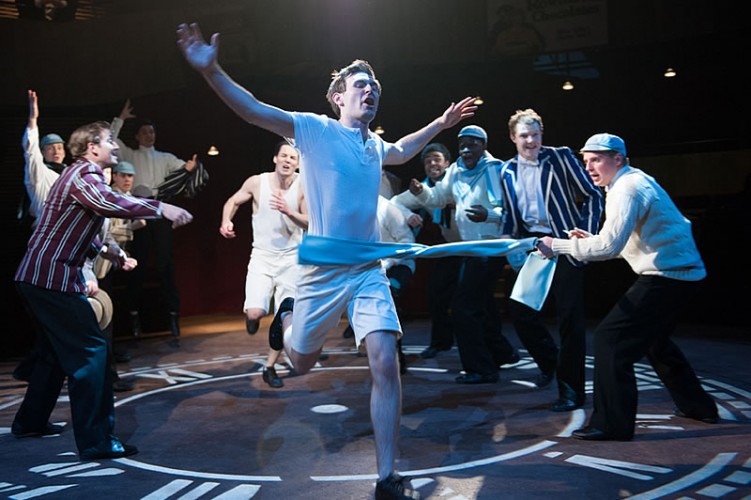
THOROUGHLY MODERN MAN: Chariots of Fire, Gielgud Theatre

This theatrical production of the Oscar winning film couldn’t be more timely.  A celebration of England and the Olympics, Chariots of Fire is performed throughout the London Olympic season.  Even for Londoners already sick of the Games, this is one event you won’t want to miss.

Under the direction of Edward Hall, the Gielgud Theatre is transformed into an Olympic stadium, a running track extending out into the audience who are sat in the round.  It’s an immersive, visceral experience and the sheer stamina and power of the actors running on the track is tangible.

The play follows the plot of the film – the true to life story of athletes Harold Abrahams and Eric Liddell in their pursuit to race at the 1924 Paris Olympics.  Both men triumphed in the face of adversity, not only in winning their respective races, but in staying true to their beliefs.  Abrahams refuses to see his Jewish faith as a hindrance during his rise to fame in the Christian world of Cambridge University.  Liddell is a devout Christian who, on arriving in Paris, refuses to abandon his religious beliefs and compete on a Sunday, the day of Sabbath.  Although the religious aspects are the focus, they are not overblown but metaphorical.  For Liddell especially, the purity of running allows him to feel “God’s pleasure” – reach Nirvana or simply relish being alive.  The narrative explores notions of achievement and the honour of immortality – universal themes that have ensured the enduring fascination in this story.

Nothing exemplifies this feeling of simply being alive more than Vangelis’s euphoric film score, which alone is enough to bring a tear to your eye and shivers down your spine.  The play also uses this music, but avoids feeling hackneyed.  The familiar piano melody accompanies Scott Ambler’s mesmerising choreography in a magnificent display of athleticism.  Replicating a hundred metre dash on stage may seem like an impossible task, but with cleverly choreographed movement making use of the central revolving stage, Chariots of Fire becomes a real spectacle that successfully captures the excitement of the race.  Waiting for the starting gun, the tension is palpable – a remarkable feat considering we all know the outcome.

The play also works as an English period drama.  This is a very British piece of theatre, not only in its celebration of English sporting success and its context of English University life, but in the use of a marching band, Scottish dancing and excerpts of Gilbert and Sullivan songs.  As such, it’s a perfect theatrical accompaniment to this year’s Games, whilst the hardships these athletes face makes an interesting contrast to modern competitors in today’s more liberal society.

Mike Bartlett’s script is surprisingly witty and full of charm, performed wonderfully by the cast.  James McArdle and Jack Lowden shine as the confident, determined Abrahams and kind-hearted, sportsmanlike Liddell, but this really is a team GB effort, acted with likeable naturalism and sung with joy.

Chariots of Fire is an outstanding piece of theatre.  If you only see one race this summer, make sure it’s this one.

Continues until 10 November, book here.

Written by a Thoroughly Modern Man, Ed Nightingale. Check out Ed’s blog, The Gizzle Review here.
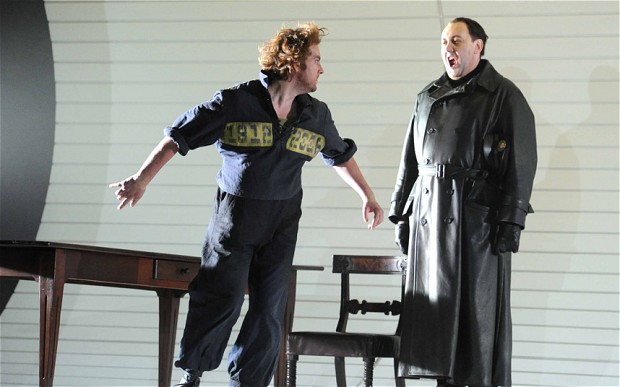
Billy Budd, ENO

With a history of performing and studying opera myself, I always find an ENO opening is an evening of spotting familiar friendly faces both on and off stage. Billy Budd was no exception with university friends and ex-music teachers sitting nearby in the audience and singing acquaintances in the cast.

The creative team from the award-winning production of Peter Grimes return to bring this new version of Benjamin Britten’s masterpiece, Billy Budd, to the Coliseum stage. It is a dark and moody show, which I felt lacked a clear vision and yet thanks to an exemplary cast of vocalists and musicians leaves a lasting impression.

Billy Budd is the second sea tale I have seen this season at the ENO after the spectacular rendition of The Flying Dutchman. This tragic opera is unique for its all male cast; the blokey chorus make quite an impact and there is something very refreshing about a narrative that is not based around a tumultuous girl-boy love affair. Billy Budd is a fiercely proud and strong sailor; aside from his occasional stammer, he is a strong member of the naval service and soon becomes a favourite of Captain Vere’s. But his inability to express himself coherently leads him to lash out and he receives the ultimate punishment for his violence.

I was most impressed by the standard of acting which is convincing across the board. In particular the contributions of Benedict Nelson as Budd and Gwynne Howell as the faithful Dansker make the production engaging and moving. Nelson makes a handsome and thoughtful Budd, though I felt he could have been more powerful vocally. Matthew Rose is a chilling Claggart, a British bass with a smooth and rich tone. The smaller roles are played by some stunning younger singers, Nicky Spence as Novice and Marcus Farnsworth as Novice’s Friend.

I found the staging a little unimaginative and I failed to understand the point of the stark set. The movement too is disappointing and I wondered what exactly the choreographer had worked on… aside from a bit of swaying the men seem to take part in very little activity.

One thing is for sure, Edward Gardner never fails to deliver and the orchestra truly do justice to this great modern British score, bringing energy and passion to the music.

Zooming down the Coliseum stairs, the ominous Britten melodies still circling in my head, a crew of cameramen caught me off guard for an interview and soundbite. Exhausted and in a daze, I hope I spoke coherently, I guess we’ll soon find out if and when the footage goes live!

Billy Budd is a Britten classic and this production shows off some of Britain’s best vocal talent.

Continues until 8 July, book here.

The Lion, the Witch and the Wardrobe, Kensington Gardens


The Lion, the Witch and the Wardrobe is an unforgettably vivid story, a classic novel by C.S Lewis that has acquired a following through manifestations on screen and stage. This whimsical production in Kensington Gardens captures the mysterious allure of the tale while adding to its fun with impressive dancing, music, puppets and aerial acrobatics.

It is a joy to once again see Rupert Goold directing, his ability to translate a story to stage is fluent and creative. The show, which you’d assume was solely catering for kids, is unpredictably good. The world of Narnia is perfectly contained in the illuminated Kensington Gardens circular tent, a challenging environment for any production. Of the night’s surprises it is the visionary puppetry that really made me gasp with excitement. The puppets are an instant reminder of the National Theatre’s hit War Horse with imaginative thrilling creatures coming to life with careful and precise human movement and intervention.

It is a seriously slick production with no blips considering the complex ideas. Trap doors, air entrances and trees on stilts are just part of the set, the rest is conjured up with ethereal video projections, a passionate score from Adam Cork and copious mist from smoke machines. The aerial work is thoroughly enjoyable, though at times perhaps a little unnecessary. It brings a circus like appeal to the show, a cross between Cirque du Soleil and the Lion King.

There is no denying that of the children Jonny Weldon as Edmund is the most captivating, a believably stroppy teenager lured by Turkish Delight. The other children, admittedly not particularly meaty roles to take on, are less sparkly on stage, though I did enjoy Rebecca Benson’s youthful enthusiasm as little Lucy. Sally Dexter is suitably venomous as the White Witch and Forbes Masson is fabulous as Mr Tumnus, producing a gorgeous countertenor sound for one of the early arias.

The great lion Aslan, is a spectacle in itself, a giant and beautiful puppet. The animal moves extremely elegantly thanks to experienced puppeteers: Christain From, Jane Leaney and Will Lucas. David Suchet provides the bellowing voice, a familiar authoritative sound that almost moved me to tears at times.

It seems perhaps counter-intuitive to produce this wintery tale at the height of summer but still through the power of escapism, this show manages to be magical, memorable and utterly mesmerising.

Continues until 9 September 2012, book here.