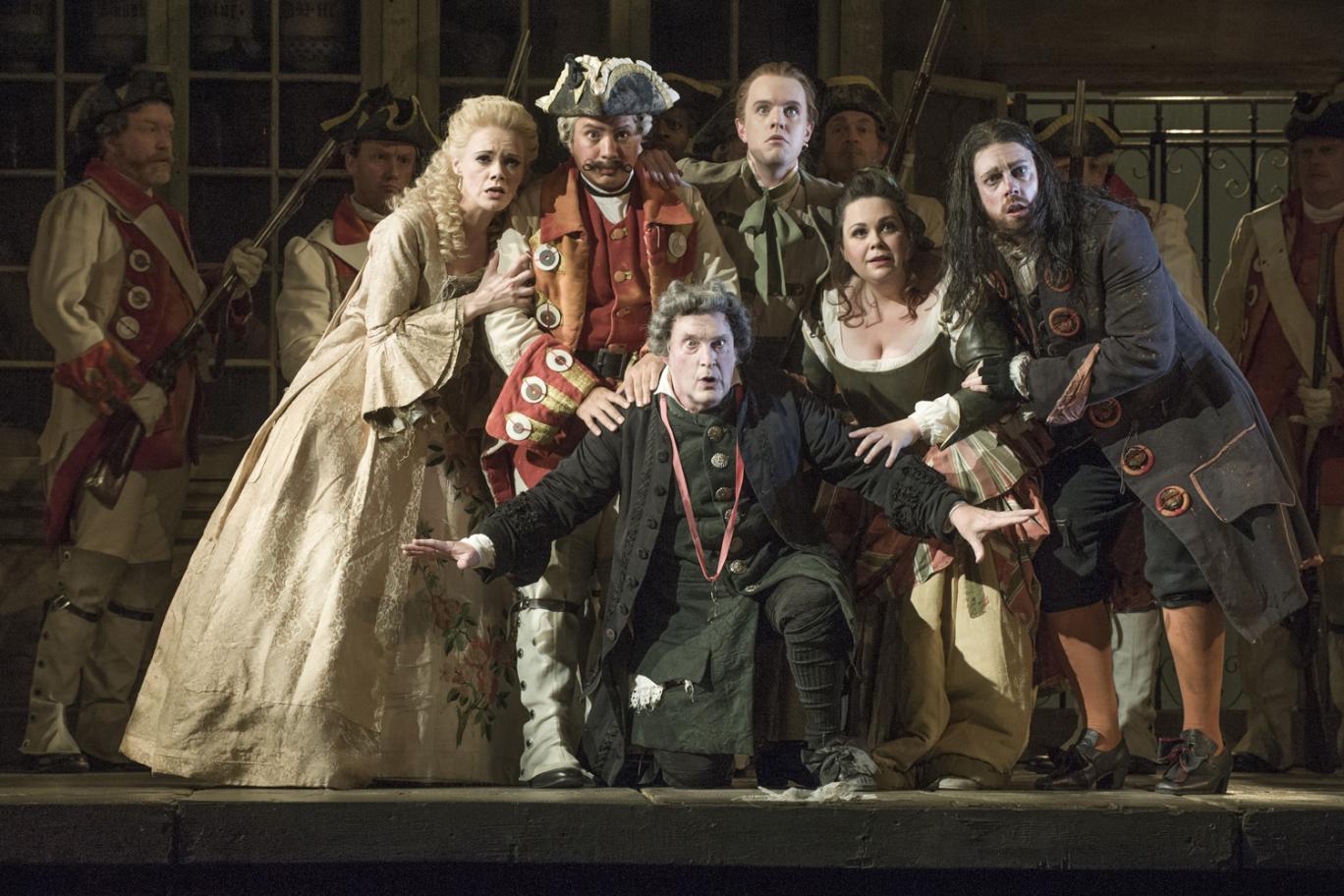
Tosca, ENO, October 2016

Tosca is a classic and returns to the great stages more regularly than most operas. After writing my university dissertation on the topic and performing as the ‘Shepherd Boy’ as a child, I have a great fondness for this Puccini masterpiece. And so, when the invitation pinging into my inbox, I immediately knew I had to clear my diary for the occasion of opening night.

Tosca ENO

We took our seats (wonderfully central in the stalls) and my friend asked me to outline the narrative. I struggled to offer up anything comprehensive, despite once studying the score in detail. The truth is, this opera is not about the story so much, it is the all-consuming music which captivates the audience. For this Catherine Malfitano revival at the ENO the cast were lead by revival director Donna Stirrup and Oleg Caetani conducts the confident and boisterous orchestra.

As the overture blasted out from the pit I was instantly entranced, and the worries from the day melted away. I was relieved to see the period set as it always unhinges me a bit to see classics set in the modern day. The creative team, comprising of designer Frank Philip Schlössmann, costume designer Gideon Davey and lighting designer David Martin Jacques did a great job… setting a dramatic and atmospheric scene for the turbulent love story.

Welsh tenor Gwyn Hughes Jones reprises his role as Cavaradossi, and the part feels very safe in his hands. Gwyn’s voice is powerful with a velvety rich tone, it is a pleasure to listen to from start to finish. He is matched by the alluring American singer Keri Alkema as Tosca, whose vocals are bold and beautiful though her spoken voice is more difficult to understand. Craig Colclough is suitably gleeful and chilling as Scarpia, though the volume of his voice is rather lack-lustre in comparison to the leading couple.

This acclaimed rendition of Tosca is powerful to watch, and wonderful to feel part of. As Tosca takes her final backwards leap I felt myself breathe out.. this opera is an emotional rollercoaster, but it is a journey I always love from curtain up to lights out.

Tosca opened on Monday 3 October 2016 at 7.30pm for 13 performances 3, 12, 14, 20, 25 October, 22, 24, 29 November, 1 December at 7.30pm, 8 October at 6.30pm, 22 October, 26 November, 3 December at 3pm.

THOROUGHLY MODERN MISSY – La bohème, ENO

It’s my experience that a successful bohème must tick 3 boxes; it needs excellent singing from the 6 main characters; undeniable chemistry between Mimi and Rodolfo; and it needs to make you shed a tear or two at the end. Bonus points for making the production fresh, and good production design but these are secondary to the three main criteria. It seems that the latest ENO bohème tried too hard to focus on these secondary criteria rather than making sure the essential boxes were ticked first.

The process of modernizing opera classics is not yet perfected. In some cases it works incredibly well and adds hugely to the production (“for example, see Jonathan Miller’s now mainstream Mafia Rigoletto). In others cases it doesn’t. Unfortunately ENO’s latest staging of bohème veers towards the latter..

In theory, the idea was not preposterous. Replacing Mimi’s outdated illness with a heroin addiction definitely updated the production and made it more relevant to today’s society as opposed to her original, outdated consumptive illness. The heroin first appears as Rodolfo stays behind at the garret (now a stark, white studio littered with bongs and carrier bags) to ‘finish a few lines’. Mimi enters and what was once one of the most touching and beautifully innocent scenes in opera is now replaced with a pair of junkies and their drug-addled infatuation with one another.

The Café Momus scene that follows the pair’s meeting is a busy, bustling feast for the eyes with the ENO chorus creating a fantastic atmosphere as they so often do. The production’s eccentricities continued as Rodolfo bought Mimi a pink wig rather than a traditional bonnet before they join the rest of the bohemians at a neon-lit diner-esque Café Momus. It is unclear whether the bright pink lights and bizarre figures in the scene are a figment of Mimi and Rodolfo’s drug-fuelled high or if it’s just the production’s attempt at modernisation.  This lack of clarity continues into the second half as the heroin was occasionally referenced, for example, Marcello lifting Mimi’s sleeves indicating ‘track marks’, but she still dies from a particularly ‘consumption-y’ cough.

Though this new production still needs to have a few wrinkles ironed out, the music was, on the whole, still excellent. Particular highlights came from Corinne Winters as Mimi and Simon Butteriss as the double part of the equally sleazy Benoit and Alcindoro.  The camaraderie between Rodolfo, Marcello, Colline and Schaunard was definitely there but on occasion the ensemble suffered. Although the chemistry between Winters and Zach Borichevsky (Rodolfo) was tangible, their heroin induced affair seemed to confuse and somewhat diminish the tenderness that has featured in more traditional productions.

Going by the initial tick-list outlined above, out of these three, I’d give the ENO’s latest production of La bohème, 1 and a half ticks; the chemistry between the two lovers was definitely there, regardless of what induced the love; some of the singing was indeed excellent, but there were some shaky moments that unfortunately do not grant an entire ‘tick’ earn only half a tick; and unfortunately not a tear was shed by the writer at the end which is usually the litmus test for any La bohème.

La bohème continues at the ENO until 26 November, book tickets here.

Written by Thoroughly Modern Missy.

THOROUGHLY MODERN MISSY: The Barber of Seville, ENO

The year is 1987; Wall Street and Fatal Attraction are the blockbusters of the year, Toni Morrison’s Beloved has just been published, legwarmers and shoulder pads are still a thing, and Jonathan Miller’s much loved production of The Barber of Seville is debuted.  Fast-forward 28 years and the production still stands firm as a crowd favourite, (happily unlike those legwarmers and shoulder pads) proving that new is not always better. Rossini’s comedic yet endearing work is a cornerstone in ‘dramma-giocoso’ opera and this production continues to uphold its reputation, even if there is that initial knee-jerk reaction of feeling confused on hearing English words replacing the familiar Italian.

In a work as full of energy and activity as Rossini’s Barber of Seville, comic timing is everything and this particular cast has mastered the delicate art of well timed physical comedy. Andrew Shore showed his penchant for comedic portrayals with his scene-stealing Bartolo. Other singing highlights included Morgan Pearse as a fresh-faced Figaro who sang the famous repeated “Figaro”s with much aplomb to the audience’s delight. Kathryn Rudge, who played the bright and charming Rosina, handled Rossini’s famously fiendish runs elegantly. These singers were generally well accompanied by the orchestra, save for a few noticeable moments when the balance was not right and the voices were obscured by heavier instruments.

Miller’s gem is still definitely worth going to see, even in it’s 12th revival, and that is something to applaud (as the audience did when Miller himself took a bow on stage). This production’s longevity is a testament to the phrase: ‘if it ain’t broke, don’t fix it’. Although Tanya McCallin’s set is very much reminiscent of the time Rossini wrote the work, and the costume is all period dress, the energy and the comedy shown by the singers keeps this production current, and will carry on doing so for yet another few more revivals to come, I’m sure.

Catch the production in cinemas across the UK on Monday 19 October or go and see it at the Coliseum until 11 November. More information here.

Written by Thoroughly Modern Missy.