The Scottish National Gallery of Modern Art is in fact two galleries, in two beautiful neoclassical houses with a road between at the quiet western end of Edinburgh. The confidently titled Sculpture Show occupies Gallery One and the grounds until June. It is by no means a comprehensive survey; that would be too difficult – the definition of sculpture is too unstable, mobile even. Within the exhibition materials develop from the homogeneity of bronze and marble to the pluralist media of today, which could be signposts (Julian Opie’s Escaped Animals), neon (statements by Martin Creed and Mark Titchner) or the landscape itself (Charles Jenck’s Landforms). Does the commandeering of everyday methods of communication make the art more relevant or just mean there is less work for the viewer to do?
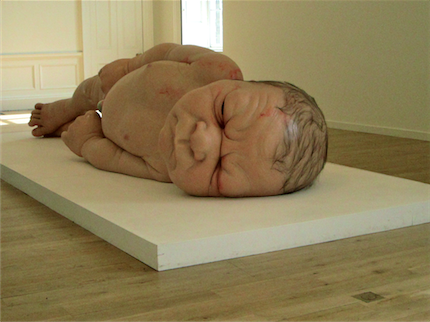
The first room one enters contains the astonishing Ron Mueck new born baby, over five metres long and super-real. Her impact is conveyed not merely by scale but also by the momentary nature of the subject: still wet and bloody from the womb, her umbilical cord cut but not yet clamped, an eye espying the world for the first time (suspiciously); the work is timeless and yet depicts a split second, and will carry on depicting that split second indefinitely. Mueck’s figures are sometimes criticised as waxwork-like but are within a tradition that is well represented in this show with Duane Hansen’s resident US tourists, a shy De Andrea nude and a coven of John Davies’s haunted men in their dusty suits.
In a new context some familiar sculpture can take on unexpected qualities – Medardo Rosso’s most famous work, the ethereal, Impressionist ‘Behold the Boy’ from 1906 alludes to human vulnerability in a way very different to the 1950s Geometry of Fear artists but no less intensely and also echoes with David Shrigley’s poignant cast of a piece of creased paper from 1997.
Elsewhere the pent-up energy of early modernism hums in bronze and stone figures by Epstein, Gill and Gaudier-Brzeska – so much power, not necessarily beauty, resides in these objects – they show up much of the flimsily conceived, room-consuming efforts of more recent artists. It is almost always true of these survey shows that as we travel through the twentieth century, the art takes up more and more space to say less and less. Roger Hiorns’ decommissioned aircraft engines stuffed with anti-depressants are perhaps an exception to this theory – they sit anxiously side by side on the lawn outside, advancing the genre of ‘found objects’ almost to breaking point.
Visit the website here.
Written by a Thoroughly Modern Mister, Chris Kenny.