THOROUGHLY MODERN MISSY: The Mastersingers of Nuremberg, ENO

As I am becoming a frequent attendee of the ENO, I am starting to notice patterns in their productions – starting with the consistently brilliant interpretations of opera director extraordinaire, Richard Jones. In his 25th year with the company, Jones has brought to the coliseum stage a production worthy of the quarter of a century celebration. Being a relatively naïve Wagner listener, having only been to one other opera of the composer, I was relieved to be watching the Mastersingers of Nuremburg in English, a trademark feature of all ENO operatic productions. The fact that the translation is one of immense artistry and delicacy merely helped make the production a memorable and beautiful gem in the ENO 2015 programme.

Visually, the production is engaging and enchanting. From the beginning of the rousing overture, the audience is presented with a game of ‘who’s who’ in the form of the front cloth; it is covered in faces of German cultural figures from Handel to Freud which firmly establishes Wagner’s ideologies of culture as the basis of the opera rather than the less fortunate reputation that the opera has acquired of extreme nationalism. As the overture comes to an end, the curtain rises to show a large ensemble – one of the largest I’ve seen on the Coliseum stage – in the midst of a church service. The 90 strong chorus are magnificently accompanied by the steadfast ENO orchestra under the sensitive and musically fluid baton of musical director Edward Garner. It is in this first scene that the audience is introduced to the blossoming romance that will keep the momentum of the opera and the storyline going.

The enormous scale of the production would deter many able and talented singers; however, every one of the 17 main singing parts were performed with such gusto and aplomb that the heavy demands of this lengthy opera seemed irrelevant to them. Hans Sachs is one of Wagner’s most developed and multi-dimensional characters. Often, performers fail to convey the depth of this character, but Iain Peterson’s interpretation was nothing short of faultless. His body language, acting and voice coalesced so well that from the second he entered the opera (running late to the mastersingers meeting), his presence dominated the stage. The ‘love-to-hate’ character, Beckmesser, was masterfully performed by Andrew Shore who played more on the insecure rather than outright malicious features of the character. Shore infused light comedy into the role, a welcomed feature for such a thematically gigantic opera. Having said that, Mastersingers is, on the whole, not a very heavy opera with many comedic parts and this was excellently carried out by the ENO company.

This production provided many moments that justify a prominent place for it in The ENO’s history, however, for me, the crowning glory was the beautifully choreographed quintet in the 3rd act. The two pairs of lovers, Magdalene (Madeleine Shaw) and David (Nicky Spence) and Walther (Gwyn Hughes Jones) and Eva (Rachel Nicholls), and Hans Sachs sing the enchanting song in his exquisitely busy cobblers workshop and create something of a religious experience for themselves and the audience. The song is meant to act as a ‘baptism’ for the stunning prize song that Walther has created – the piece of paper is hoisted into the air, much like a symbol of the holy spirit and the lighting is done in such a way that the paper seems to glow. This, paired with the breathtaking execution of the quintet was an incredibly moving moment in the already affecting opera.

Do not let the nearly six-hour running time deter you – this is a production worth making the time for. It is an art lover’s masterpiece and justifies the ‘noble German art’ of which Hans Sachs sings at the end, as a vibrant component of today’s performing arts repertoire.

Show continues until 10 March, more information and book here.

Written by Thoroughly Modern Missy, Angelica Bomford.

The Flying Dutchman, Budapest State Opera

Wagner’s ‘The Flying Dutchman’ is difficult enough to grasp in English, but sung in German with Hungarian subtitles, it is impossible. Having seen an ENO production, I felt I had some understanding of the piece, but this strange Hungarian realisation seemed to throw all logic out the window. This entirely new production launches the Budapest State Opera’s 2013 season and celebrates Wagner’s bicentenary.

The Budapest Opera House is amazing, and recommended in all the guidebooks as a must-see attraction in the city. Located on the main Andrassy Boulevard, it is very central and surrounded by cute bars and cafes (including the renowned Ring Cafe burger bar). The building is one of the most significant icons of the city, a symbol of the rich Hungarian operatic tradition.

I was expecting great ballgowns and smart suits but this premiere evening seemed to be quite a solemn affair for the Hungarian crowd who barely dress up for a night at the opera. We were by far the youngest and least stern visitors in attendance for opening night!

This version of the opera is eccentric and mysterious, with crazy costumes and a futuristic set. I thought Thomas Gazheli was rather weak as the Dutchman, he struggled with the presence needed for this epic Wagnerian role and appeared lacklustre. Leading Lady Lukacs Gyongyi was the most promising singer of the night, blossoming during her solo arias, and working well with others.

Check out the programme before committing to tickets at the Budapest Opera House, find an opera you recognise and the evening could be a highlight of your trip, but if you are unsure of the work I’d give it a miss… Hungarian is not an easy language to interpret or understand.

More information here.

http://www.opera.hu/en

The Flying Dutchman, ENO

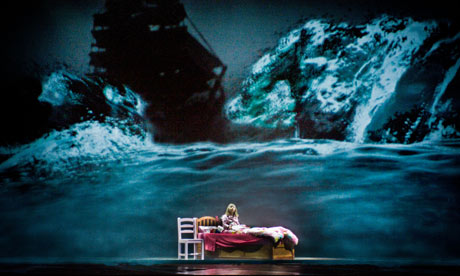
The Flying Dutchman is one of Wagner’s earliest operas and is unusually short by Romantic opera standards, however within the score it is easy to identify themes and musical motifs that appear throughout his later work. Following the unanimous success of Parsifal last year, an ENO dream team introduce another Wagner masterpiece and when I bumped into several opera keen friends at opening night, I realised just how highly anticipated this production was.

It is a mysterious tale of a ghostly sea captain, riding the seas anxious to find a suitable woman who will be faithful till death. He meets with a lost seafarer and soon discovers that in return for his fortune he can gain a wife. The young Senta roams the stage throughout the first act, missing her father who only returns from sea every seven years. Senta is possessed mind and soul by the storybook telling the tale of the Dutchman and his need for a wife. When her father returns home years later with the Dutchman, Senta is at last relieved of her anguish. They are reunited much to the disgust of the town. Unable to cope with Senta’s unrealistic dreams Erik tries to convince Senta that her destiny lies with him, spying the couple the Dutchman leaves. Tormented by the loss of her love, Senta kills herself unable to imagine life without him.

The cast is all round impressive, in particular the desperate lover Erik sung by Stuart Skelton and Clive Bayley as Senta’s father who has a strong charismatic bass voice that is very enjoyable to listen to. James Cresswell is moody and brooding as the Dutchman but vocally he lacks substance and could have been more emphatic. Orla Boylan has an appropriately big voice for the female lead, Senta.

It was a great pleasure to see Edward Gardner in the pit once again, conducting his first Wagner opera. Obviously enjoying the power and energy of the score, he led with great enthusiasm and the orchestra responded well providing a strong backbone for the singers. The epic sets suit the dramatic Wagnerian story perfectly, a masterpiece from Paul Brown, and Nina Dunn’s video designs are extremely atmospheric and cleverly made.

The ENO’s ‘Flying Dutchman’ passes with flying colours, a real triumph to start the new season.

Continues until 23 May, book here.