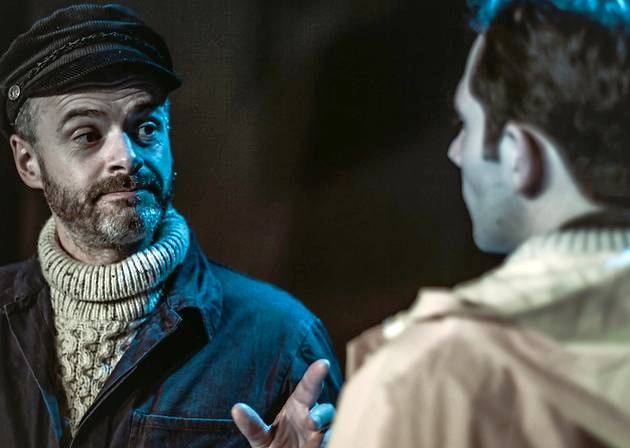
Drowning Rock is an ambitious attempt, perhaps overly so, at recreating a cinematic style of gothic horror storytelling. Told in two time frames, Hawker’s son narrates his father’s story from notes discovered in an old sea chest, taken at Drowning Rock, the site of his grandfather’s adventures before him. The production is reminiscent of the now iconic horror tale, The Woman in Black, in that a city dweller is transported from his comfort zone to a harsh, intimidating provincial extreme. Here, Hawker is exposed to “the good the bad, and the even worse” of the sea, and it is in this that the horror lies.
John Gregor was impressive as Roper, the old sea dog, the reserved, laconic senior statesman of the lighthouse. The whole storyline, however, needed to be orchestrated, led, grabbed by the scruff of the neck by Hawker (Andrew O’Donoghue), in his role as narrator. Sadly, his performance fell flat. Without a strong lead, the success of the drama was dissipated, due to an inability to maintain dramatic tension for any length of time. On this micro-scale of theatrical production, any “special effects” will necessarily fall short of expectations, and Drowning Rock needed to be able to rely more on the power of Hawker’s central storytelling role to hold the audience, instead of shining torches into their eyes. On this occasion, sadly, O’Donoghue seemed lost at sea himself, and Drowning Rock suffered as a consequence.
It had promise in terms of the material, and if it were given a better crack of the whip, with a bigger budget, this could be a very effective and moving production. On one or two occasions, it really did capture the spirit of gothic, fireside storytelling for which it strived, but these were too rare over the course of the performance; sadly this time it was more washed out than knock-out.
More information here.
Written by a Thoroughly Modern Man, James Bomford.